GMing for Mixed Skill Tables: From Newbies to Rules Lawyers
What to Do when you have players across the experience spectrum
Dear Readers,
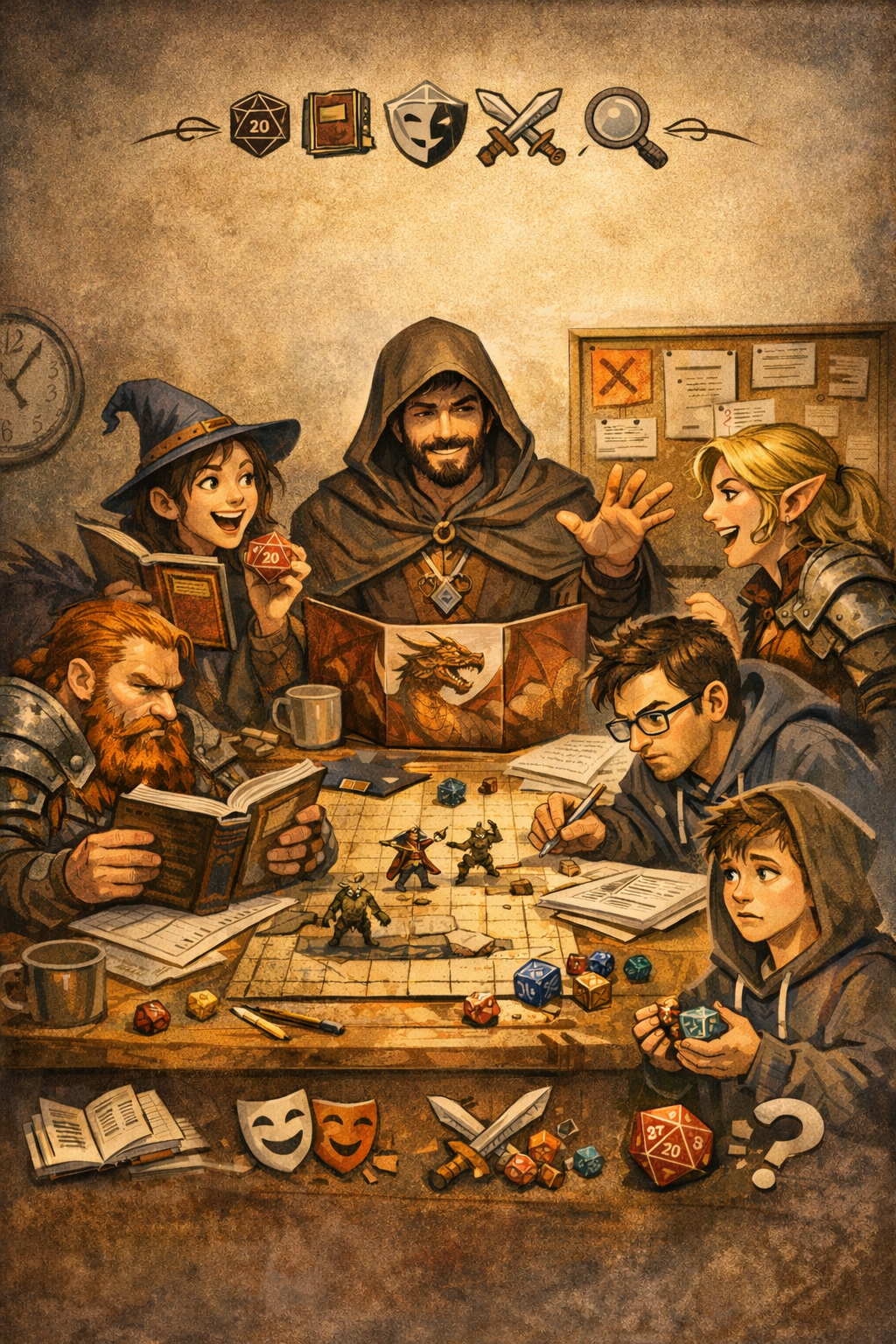
You can feel it in the first ten minutes. One player is already asking whether flanking is in this edition and how it interacts with advantage. Another is still finding the “d20” in their dice pile like a turtle. Someone else is here for big character moments, and the last player’s eyes sparkle whenever you say “tactical map.” Welcome to the mixed-skill table: a beautiful, chaotic ecosystem where different kinds of fun share a habitat.
Mixed-skill tables aren’t a problem to be solved. They’re a reality to be designed for. And if you ever run games at conventions—where strangers sit down with wildly different experience levels, expectations, and attention spans—this becomes less “nice to have” and more “core competency.” A convention table is a mixed-skill table by default. Your job is to make it sing anyway.
Let’s talk about how.
The hidden truth: “skill” isn’t one thing
When someone says “I’m new” or “I’m experienced,” they might mean any of these:
- Rules literacy: knowing the system, options, edge cases, and common combos.
- Table literacy: knowing how to share spotlight, read the room, and pace play.
- Character literacy: knowing how to roleplay, make strong choices, and pursue goals.
- Tactical literacy: knowing how to solve problems with positioning, resources, and teamwork.
- Social confidence: being comfortable speaking up, improvising, and taking initiative.
- Genre literacy: understanding the tone, tropes, and what “good play” looks like in this game.
A “rules lawyer” might be high on rules literacy but low on table literacy. A newcomer might be low on rules literacy but high on creativity and social confidence. If you treat all of this as a single slider from “new” to “expert,” you’ll misdiagnose what’s happening and apply the wrong fix.
Instead, picture a party sheet with six different stats. Your job as GM is to balance encounters for the whole party—not just the fighter with a magic sword.
Name the archetypes, then design for them
People are more complicated than labels, but archetypes help you prep. Here are common ones at mixed-skill tables:
- The Newcomer: wants to play, doesn’t want to slow things down, needs scaffolding.
- The Rules Lawyer: knows the rules and wants fairness, consistency, and clarity.
- The Power Builder: enjoys optimization, combos, and mechanical expression.
- The Actor: loves character voice, emotional beats, and relationship drama.
- The Tactician: wants crunchy choices, terrain, and problem-solving under pressure.
- The Wanderer: is here for vibes, exploration, and surprises; can drift if not anchored.
You don’t need to “manage” these people like they’re problems. You need to feed them. Mixed tables go sour when one archetype gets a full meal and another gets crumbs.
So think in session design terms: every hour, can you include at least one moment that feels like “their kind of fun” for each archetype present?
The three principles that keep everything from catching fire
1) Clarity beats complexity
Mixed tables fall apart when players can’t predict how the game works. You don’t need perfect rules mastery; you need consistent, communicated patterns.
That means:
- Use the same procedure for common actions (“Here’s how we handle stealth,” “Here’s how we do social scenes,” “Here’s how we resolve travel hazards.”).
- Say out loud when you’re making a ruling vs. citing a rule.
- Keep your house rules short and written.
2) Speed is kindness
When skill levels vary, the biggest threat is not “wrong rules.” It’s stalled momentum. Every stalled moment widens the gap between experienced players (who stay engaged) and newer players (who feel lost).
Speed is kindness because it keeps everyone in the shared story.
3) Spotlight is a resource, not a reward
Spotlight shouldn’t go to the loudest player or the most optimized build. It should move intentionally. When you treat spotlight like an economy—something you distribute, refresh, and invest—mixed tables thrive.
Start strong: the 5-minute table contract
You don’t need a full Session Zero every time—especially at conventions. But you do need a quick table contract. Five minutes, tops. Hit these points:
- Tone: “Heroic fantasy,” “grim horror,” “silly pulp,” etc.
- Safety: a quick safety tool (X-card, lines/veils, or a simple “tap out” option).
- Rules posture: “We’ll keep it moving; I’ll make quick rulings and we’ll look up rules after the scene.”
- Spotlight promise: “I’ll make sure everyone gets moments. Help me by keeping cross-talk supportive.”
- Player agency: “Tell me what your character wants. I’ll build toward that.”
This does two things. It gives newcomers permission to be new, and it gives rules-focused players a framework for when precision matters and when pacing wins.
At conventions, this contract is gold because it turns strangers into a temporary team with shared expectations.
The four dials you can turn mid-session
When a mixed table starts wobbling, don’t panic. Turn a dial. You have four reliable controls:
- Structure: add procedure (“We’ll go around the table,” “We’re in initiative,” “We’ll take turns asking questions.”).
- Fiction: zoom in on the scene (“What do you see?” “What are you afraid of?” “What does it smell like?”).
- Pressure: add time, cost, or consequence (“The guards arrive in two rounds,” “The ice is cracking,” “You’re spending supplies.”).
- Support: lower the barrier (“Here are three options,” “You can ask one clarifying question,” “We’ll treat this as a simple check.”).
Newcomers often need support. Veterans often need pressure. Actors often need fiction. Rules lawyers often need structure. You can rotate these dials without calling attention to the meta-game, and your table will feel like it has invisible stabilizers.
The “Rulings Ladder” for rules lawyers (and your sanity)
Rules lawyers aren’t villains. Many of them are guardians of fairness. The trick is to partner with them without letting rules debates hijack the session.
Use a simple ladder:
- Player cites quickly: “The rule is on page X” or “It’s in the SRD under Y.”
- GM decides fast: “Yes,” “No,” or “We’ll do it this way right now.”
- Mark it for later: keep a sticky note or a phone note labeled “Rules to verify.”
- Follow up: between sessions—or after the con slot—confirm and adjust future rulings.
The key is step 2. You must decide fast. Even if you’re wrong, the table stays together. And your rules-focused players will respect you more if you’re consistent and transparent than if you’re constantly uncertain.
Pro tip: give your rules lawyer a job. “Can you be my page-finder? If I ask, help me locate the rule fast.” This turns a potential derailment into a support role with boundaries.
Another pro tip: when they correct you, treat it like a gift, not a challenge. “Thanks—good catch. For tonight we’ll keep my ruling, and I’ll verify after.” That line preserves their identity (helpful expert) while protecting momentum (the real boss monster).
Teaching without lecturing: the “menu, not manual” approach
New players don’t need a lecture on all possible actions. They need a menu of good options right now.
When it’s a newcomer’s turn, offer three to five choices framed in fiction:
- “You can shoot the cultist, dive behind the pillar for cover, or try to grab the idol before they do.”
- “You can persuade the guard, bribe them, or look for a way around the gate.”
- “You can cast a spell, help your ally, or try something risky like swinging from the chandelier.”
Then ask, “What feels like your character?” This preserves agency while lowering cognitive load.
Over time, widen the menu. The goal is not to teach every rule; it’s to teach how to make choices in this game.
At conventions, this is essential. You have limited time, and most players want to feel competent quickly. The menu approach gets them into the fun in minutes.
The “buddy rule” that supercharges onboarding
If you can, quietly pair each newcomer with a veteran at the table. Not as a babysitter—more like a wingman. The veteran can answer small questions (“What dice is that?” “Where’s your attack bonus?”) while you keep the scene moving. Tell the table upfront: “Help each other; I’ll keep narration flowing.”
This is especially powerful at conventions because it turns a random table into a cooperative learning space. Most experienced players like being useful. Most new players like having a low-stakes lifeline.
Encounter design for mixed tables: build in multiple lanes
A mixed-skill encounter should have more than one way to contribute. Think of it like a multi-lane highway.
Lane 1: Direct action
The tactician and power builder want meaningful choices: targets, positioning, resources, timing.
Add:
- terrain features that matter (cover, elevation, hazards),
- objectives beyond “kill everything” (hold a door, disrupt a ritual),
- visible enemy tells (“the shaman is charging a spell”).
Lane 2: Clever action
The newcomer and wanderer often shine when creativity matters.
Add:
- interactive objects (chandeliers, boiling cauldrons, loose scaffolding),
- NPCs who can be influenced mid-scene,
- consequences for bold ideas that aren’t just “no.”
Lane 3: Social or emotional action
The actor wants stakes that touch identity, relationship, or theme.
Add:
- an enemy who hesitates,
- a hostage who recognizes a PC,
- a choice that costs something emotionally (save the artifact or save the villagers).
In practice, you can do this with one encounter. A cult ritual on a bridge can be tactical (positioning), clever (cut ropes, knock over braziers), and emotional (a captive mentor).
Lane 4: The rules lane (yes, really)
Some players genuinely enjoy “doing it right.” Give them a lane too. Add moments where careful procedure is satisfying: tracking resources in a survival scene, using conditions properly in a combat, or running an investigation with clear clue-handouts. The trick is to keep it crisp, not fussy. Think of it like seasoning: enough to notice, not enough to dominate the flavor.
Spotlight choreography: the “turn-taking” you don’t see
Mixed tables need subtle facilitation. Here are techniques that feel invisible but work wonders:
The pass
After one player resolves a moment, pass spotlight with intention: “Great. While that’s happening, Nia—what’s your character doing?” This keeps louder players from taking the next bite automatically.
The hook
When a quiet player speaks, hook them to the next scene: “You notice the symbol on the door is the same as your family crest. What do you do?” This turns participation into momentum.
The clock
Use time pressure to prevent over-analysis. “You have about ten seconds before the guard returns.” Analysis paralysis often hits experienced players because they see all possibilities.
Clocks push action.
The cut
In long scenes, cut like a film editor. “We’ll come back to that. Meanwhile…” This keeps engagement high across experience levels.
The round-robin question
In social scenes, borrow initiative without calling it initiative. Ask one question per player:
“What’s your angle here?” “What do you offer?” “What do you notice?” It prevents the charismatic player from negotiating alone while everyone else watches.
Two-speed play: letting experts go deep without leaving newcomers behind
Sometimes you want crunchy depth. Sometimes you want fast cinematic flow. You can have both—if you run the table in two speeds.
- Speed One (Cinematic): quick rulings, broad actions, minimal math. Great for chases, crowds, and chaotic scenes.
- Speed Two (Tactical): precise positioning, clear options, measured turns. Great for set-piece fights and puzzles.
The mistake is switching speeds without signaling. When you change gears, say it in fiction: “This is a tight fight. We’re going into full initiative.” Or: “This is a scramble—tell me what you do and we’ll resolve it fast.”
Newcomers feel safer when they know which mode they’re in. Veterans feel respected when tactical moments get the attention they deserve.
Make optimization welcome, not dominant
Power builders can make newcomers feel useless if the game revolves around damage and efficiency. The fix isn’t to nerf builds. It’s to broaden what success looks like.
Reward:
- information gathering,
- alliances,
- resource management over time,
- moral choices,
- clever avoidance of danger.
Also, occasionally design problems where raw power isn’t the best tool. A locked-room mystery, a chase, a negotiation with a fey court—these let other skills shine.
When the optimizer does something cool, celebrate it. Then look for the next moment to celebrate someone else. You’re not balancing builds; you’re balancing experiences.
The “spotlight button” trick
Give each character (especially pregens at conventions) one clearly framed, once-per-session move that invites spotlight. It can be mechanical or narrative:
- “Once, you can declare you prepared a useful tool.”
- “Once, you can flash back to a prior connection with an NPC.”
- “Once, you can push yourself and reroll, but you take a consequence.”
Newcomers love having a shiny handle to grab. Veterans love having permission to be dramatic. Everyone gets a moment that feels like the story noticed them.
Social friction: handle it like a professional
Mixed tables sometimes create tension: “Stop arguing rules,” “Stop making jokes,” “Stop being slow,” “Stop optimizing.”
The best GM move is to intervene early and kindly, with specific behavior requests.
Try:
- “Let’s keep rules calls to ten seconds; I’ll rule and we’ll move.”
- “Let’s make sure everyone gets a say before we decide.”
- “Jokes are welcome, but let’s keep the scene’s tone for this moment.”
- “On your turn, tell me your intent first; we’ll find the mechanic together.”
Notice these aren’t attacks on personality. They’re adjustments to table behavior.
If it escalates, use the private reset: “Hey, I want you to have fun, and I also need us to share space. Can you help me keep things moving?” That one-on-one moment prevents public defensiveness.
At conventions, this matters even more. People paid for an experience. Your job is to keep the table safe, fun, and moving.
The convention crucible: why mixed-skill mastery matters
Running for friends is one kind of craft. Running at conventions is another. Con games are:
- time-boxed (often 3–4 hours),
- cold-started (no campaign context),
- socially diverse (strangers, different norms),
- high-variance (wild skill gaps),
- high-stakes (people want their money and time respected).
A convention table magnifies every weakness in your facilitation. If you can GM a mixed-skill con table smoothly, your home games will feel like you unlocked a new difficulty setting—on purpose.
Here are con-specific practices that help mixed tables immediately:
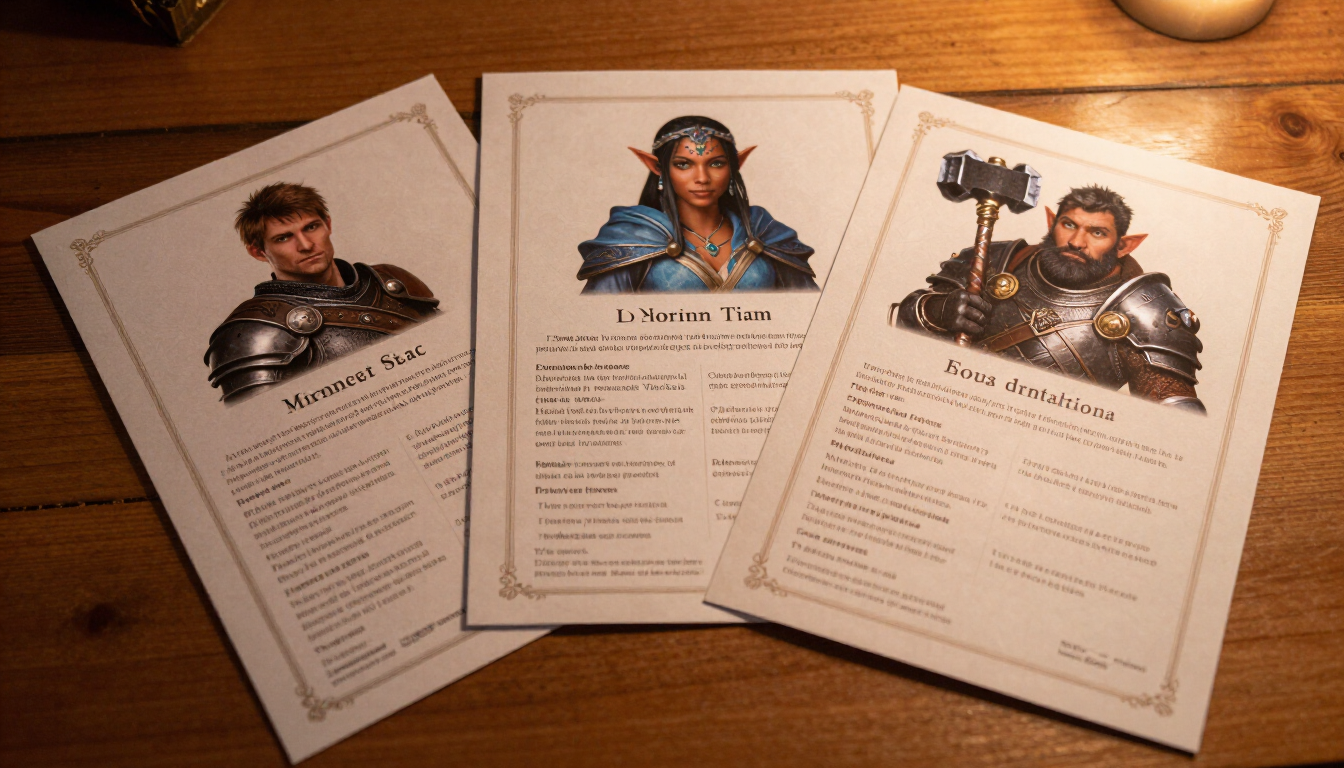
1) Pregens with clear hooks
Provide characters with:
- one sentence of personality,
- one relationship tie,
- one mechanical “spotlight button” (“Once per session, you can…”),
- and a clear goal.
Newcomers love the clarity. Veterans appreciate the efficiency.
2) Table tents and names
Put names (player and character) on folded cards. It lowers social friction and speeds spotlight passing: “Jamal, what does Kestrel do?”
3) Teach the core loop, not the lore
In the first five minutes, demonstrate the game’s core loop: “You tell me what you attempt, I tell you what to roll, we narrate the result.” That’s the engine.
4) Timebox decisions
Use gentle limits: “Two minutes to plan; then we act.” Con games die in planning meetings.
5) Visible objectives
Write the current objective on a card in the center of the table: “Stop the ritual” or “Escape the sinking ruins.” This helps newcomers and keeps rules debates grounded in purpose.
6) The “parking lot” note for questions
Keep a visible “parking lot” index card: rules questions, lore questions, and “cool ideas we didn’t have time for.” It reassures everyone that their curiosity is valued without letting curiosity eat the session.
7) End with a strong landing
Con players remember endings. Build toward a clear climax, then an epilogue beat where each character gets a final moment. Mixed-skill tables love this because it guarantees everyone a last spotlight.
8) Build for drop-in variance
Sometimes a con table is missing a role: no healer, no face, no rogue. Design your scenario so it doesn’t require a specific class function. Include multiple ways past obstacles, and make sure “failure” still moves the story forward with a cost. In convention play, a hard stop is the enemy.
Practical tools you can prep once and reuse forever
The one-page cheat sheet
Make a system-specific one-pager:
- turn structure,
- common actions,
- conditions,
- how spellcasting works (at a high level),
- and a mini glossary.
Hand it to newcomers. It reduces questions and boosts confidence.
The “intent-first” prompt
When someone hesitates, ask:
- “What do you want to achieve?”
- “How are you trying to do it?”
- “What are you afraid will happen if you fail?”
This works for both newbies and experts. Experts sometimes get trapped in mechanics; intent pulls them back into fiction.
The default ruling
Choose a default for uncertain moments, like “roll and we’ll interpret,” or “advantage/disadvantage for situational factors,” or “DC 15 unless obvious.” Consistency beats perfect accuracy.
The spotlight tracker
Use a tiny checklist with player names. Make a mark each time someone gets a major moment. If someone is low, aim the next scene toward them.
This is the quiet magic that makes mixed tables feel fair.
The debrief that upgrades your next session
End with two minutes of feedback. Keep it simple:
- “One moment you loved.”
- “One thing you want more of.”
- “One thing to clarify next time.”
At conventions, this can be a quick “stars and wishes” round right before the final applause. It builds goodwill, helps you improve, and gives newcomers a chance to name what worked for them.
A mini-example: one scene, five kinds of fun
Picture this: the party reaches a museum at night. A rival crew is already inside, stealing a relic.
A security golem wakes up.
- The tactician gets terrain (balconies, display cases, skylights).
- The power builder gets a crunchy challenge (disable the golem’s power core).
- The actor gets an emotional hook (the relic is tied to their backstory).
- The newcomer gets a clear menu (chase, hide, distract, help).
- The rules lawyer gets clarity (a simple procedure: “three rounds until alarms trigger; here’s how stealth works tonight”).
Same scene. Multiple lanes. Everyone eats.
Scripts you can steal (especially for conventions)
When you’re tired, under a clock, and juggling five playstyles, scripts are life-saving. They keep your tone calm and your boundaries clear without you having to improvise “professional GM voice” on the spot.
The opening con spiel (60 seconds):
“Hi folks, I’m your GM. We’re here to tell a cool story together, and we’re on a time box, so I’ll prioritize forward motion. Tell me what you want to do in the fiction; I’ll tell you what to roll. If a rule question pops up, we’ll do a quick ruling and keep going, and I’ll note it for later. I’ll make sure everyone gets spotlight—help me by cheering for each other’s moments.”
The quick ruling line:
“I’m going to rule it this way right now so we keep momentum. If we learn later the written rule is different, we’ll adjust next time.”
The rules lawyer partnership line:
“I appreciate you keeping us honest. If you can point me to a page fast, great. If not, we’ll park it and keep rolling.”
The newcomer empowerment line:
“You’re not expected to know the system. Just tell me your intent—what you’re trying to accomplish—and we’ll translate it into dice together.”
The cross-talk soft stop:
“I want to hear everybody, so let’s do one voice at a time. I’ll go around the table.”
The optimization balance line:
“That combo is awesome. Let’s see how it changes the battlefield—and then I want to cut to what the rest of you are doing.”
These aren’t magic words; they’re guardrails. Players relax when they know what the table’s procedure is, and relaxation is what lets mixed-skill tables take risks.
The fairness triangle: consistency, transparency, compassion
Mixed tables frequently argue about “fair.” Here’s the trick: fairness has three corners.
- Consistency: similar situations get similar rulings.
- Transparency: people understand why a ruling happened.
- Compassion: the ruling serves the table’s fun, not the GM’s ego.
Rules lawyers tend to prioritize consistency. Newcomers tend to need compassion. Everyone benefits from transparency. If you feel stuck, ask yourself which corner is missing, then patch that corner.
For example, if you make a fast ruling that surprises someone, add transparency: “I’m treating this like difficult terrain because the floor is slick with oil.” If a consistent ruling keeps punishing a new player, add compassion: “You can reposition; we’ll treat that as part of your move this time.” If compassion is starting to feel like favoritism, restore consistency by writing the house rule down.
At conventions, the fairness triangle is especially important because players don’t have long-term trust built with you. Consistency and transparency are how you earn trust fast; compassion is how you keep the table kind.
The post-game glue: how to leave everyone smiling
A mixed-skill table can feel messy in the middle and still be a triumph at the end. Before people scatter (especially at conventions), take one minute to name wins: “I loved the clever chandelier stunt,” “That negotiation was tense in the best way,” “Great teamwork in that final push.” Then invite a lightning round of appreciation player-to-player. It sounds corny until you see how effectively it turns strangers into allies.
If you’re running multiple convention slots, jot one sentence about what worked for each archetype at that table. That tiny note becomes your evolving playbook: which procedures keep you fast, which scenes teach the system smoothly, and which moments reliably share spotlight. Iteration is the secret boss fight of good GMing, and you get better every time you loot it.
The closing spell: be the translator between playstyles
A mixed-skill table asks you to be a translator. You translate rules into story for newcomers. You translate story into rulings for rules lawyers. You translate spotlight into belonging for quiet players. You translate time into urgency for planners. And you translate the whole messy human mix into something that feels like a single adventure.
If you can do that, you’re not just running games. You’re running a small, temporary civilization powered by dice and imagination. Which is, frankly, one of the cooler uses of human consciousness.
Until next time, Dear Readers...