Villain Logistics 101: Supply Lines, Payroll, and How Heroes Break Empires
Logistics, Not Just For PCs!
Dear Readers,
Your villain is terrifying.
They have a tower. A title. A theme song. Maybe even a signature laugh that makes candles flicker.
And yet… the villain’s entire operation can be undone by something profoundly unsexy:
They still have to feed people. Pay people. Move stuff.
Even the most apocalyptic necromancer isn’t powered by vibes alone. Somebody is delivering grave-dust. Somebody is hauling black stone. Somebody is repairing carts. Somebody is bribing guards. Somebody is laundering coin. Somebody is making sure the cultists have candles, ink, robes, and a place to sleep that isn’t “the damp floor under the altar.”
Villain logistics are the secret DM lever for three huge upgrades:
- Your world feels real because evil has infrastructure.
- Players gain new ways to win besides “kick in the door and roll damage.”
- Your campaign becomes smarter because strategy emerges naturally from the fiction.
This post is a practical toolbox for building villain operations like ecosystems—with supply lines, payrolls, and pressure points—so your players can topple empires like clever heroes instead of endlessly grinding through minions.
No spreadsheets required. (Unless you want them. I see you, spreadsheet goblins.)
The core idea: every villain has a machine
Most villains are portrayed as individuals: the lich, the warlord, the archmage.
But what players fight in a campaign is almost never a single person. They fight a machine:
- a network of agents
- sources of power and materials
- routes of movement
- social cover
- information channels
- enforcement arms
When heroes break the machine, the villain becomes vulnerable—sometimes without a climactic battle at all.
If you want your campaign to feel like the party is changing the world, not just winning fights, villain logistics are how you do it.
The Three Mundane Weak Points (that will ruin a villain’s whole week)
Here’s the simplest framework I’ve ever used that consistently produces good play:
1) Supplies
What they need to operate:
- food, water, shelter
- weapons, armor, ammo
- ritual components
- medicine
- beasts of burden
- fuel (coal, oil, magic crystals)
- replacement parts
- rare reagents
- bodies (for undead, experiments, sacrifices)
- time-sensitive ingredients (fresh blood, new moons, unspoiled herbs)
If heroes disrupt supplies, the villain’s power shrinks over time.
2) Money
How the machine pays for itself:
- taxes, tribute, protection rackets
- stolen goods
- black market trade
- patronage from nobles
- gambling dens and smuggling
- mining operations and forced labor
- “charities” and fronts
- devil contracts and “donations”
If heroes disrupt money, the villain loses loyalty and reach.
3) Reputation
The social permission structure that keeps the machine standing:
- fear (“don’t resist or you’ll vanish”)
- legitimacy (“we’re the lawful rulers”)
- inevitability (“resistance is pointless”)
- holiness (“the gods chose us”)
- propaganda (“the rebels are monsters”)
- secrecy (“no one knows who’s behind it”)
If heroes disrupt reputation, the villain loses cover and recruits.
Supplies, Money, Reputation. That’s the triangle.
When your players don’t know what to do next, point them at the triangle. When you want meaningful non-combat objectives, choose a point on the triangle. When you want consequences, let the triangle react.
Build the villain like a dungeon: nodes and routes
You don’t need to map an empire. You need a handful of nodes (places/people) and routes (connections).
A villain machine can be sketched in ten minutes:
- Node A: Source (where it comes from)
- Node B: Processing (where it’s transformed)
- Node C: Storage (where it’s stockpiled)
- Node D: Distribution (where it gets moved out)
- Node E: Front (where it looks legal/normal)
- Node F: Enforcement (who keeps it safe)
Routes connect nodes: roads, rivers, portals, smugglers, courier birds, bribed gatehouses.
You only need 5–7 nodes for a whole campaign arc. Players will generate the rest by interacting with it.
Example: The necromancer’s corpse economy
- Source: grave robbers and plague pits
- Processing: bone-mill and embalming vats
- Storage: catacombs beneath a chapel
- Distribution: midnight wagon route to outposts
- Front: “funeral services” guild
- Enforcement: masked “grave wardens” (actually thugs)
Now the heroes can attack the machine anywhere:
- stop grave robbers (supplies)
- expose the funeral guild (reputation)
- seize the wagons (supplies)
- bankrupt the front (money)
- flip an enforcer (reputation + intelligence)
That’s a whole arc, and it’s not “storm the tower” until the end—when the tower finally matters.
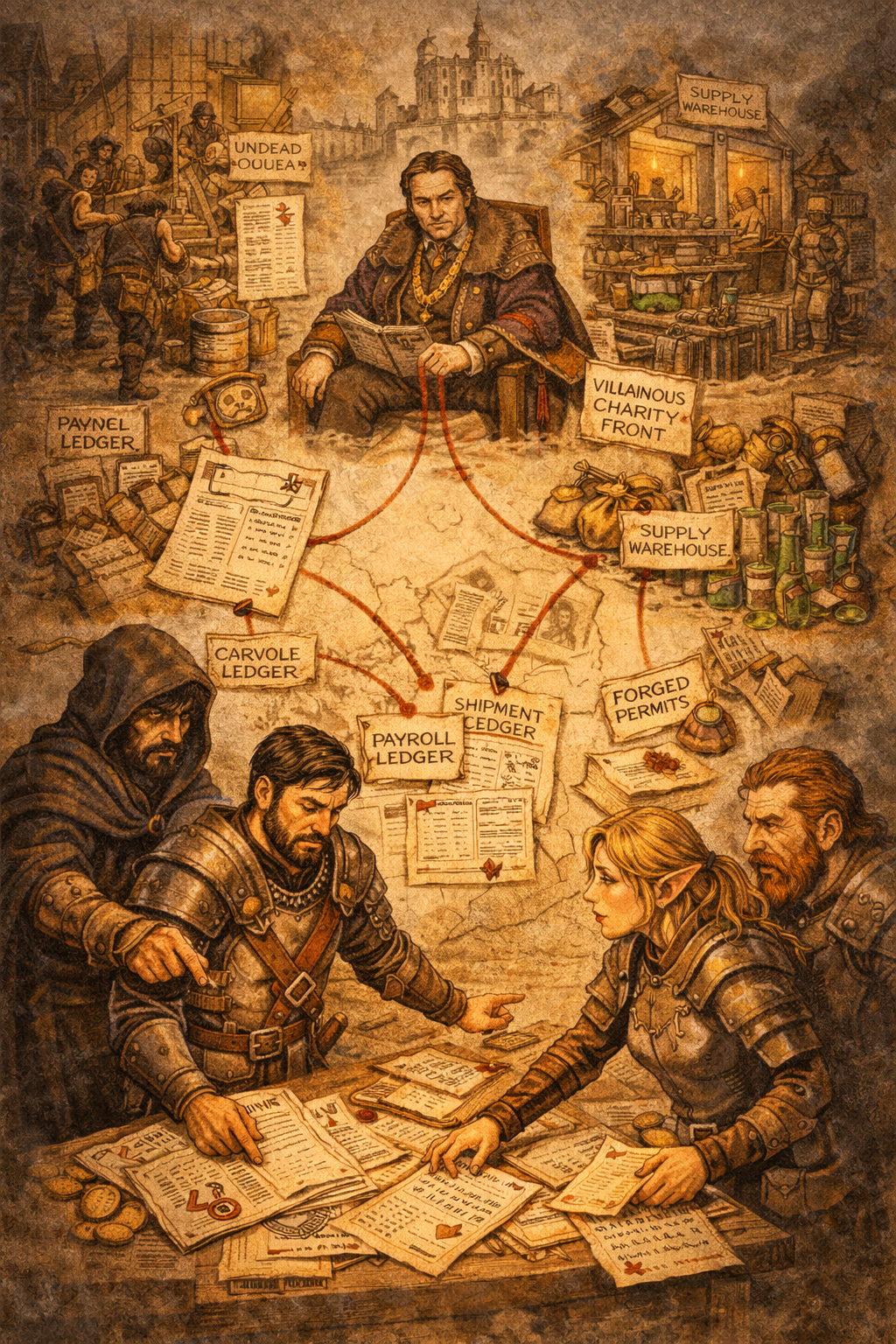
Make the logistics visible: give players evidence
Players can only make strategic choices if they can see the system. So you need to surface logistics through play.
Give them clues like:
- ledgers and receipts
- shipping manifests
- crates with markings
- overheard schedules (“wagons leave on Moonday and Starday”)
- pay chits for mercenaries
- coded messages (“the eels arrive at midnight”)
- a shortage in town (why are torches suddenly expensive?)
- guards getting paid unusually well
- a public festival sponsored by “The Benevolent Society” that’s definitely laundering money
The goal is not to dump lore. The goal is to make the villain’s machine touchable.
Players will do the rest: they’ll start asking, “Where are these wagons coming from?” and suddenly you’re running a campaign about supply chains, which is both hilarious and genuinely compelling.
The villain payroll: loyalty is rented, not owned
Most villains don’t command perfect loyalty. They rent it.
Mercenaries, bandits, corrupt officials, informants, even cultists—many of them are there because it’s profitable, safe, or socially rewarded.
That means payroll is a weak point.
Four payroll truths that create instant story
- People talk when hungry.
- People switch sides when scared.
- People sell secrets when desperate.
- People betray when the villain stops looking invincible.
So when players hit the villain’s money, you can show consequences quickly:
- guards get sloppy
- mercenaries demand hazard pay
- informants stop reporting
- bribes dry up
- internal power struggles begin
- the villain starts taking risks to compensate
That’s narrative momentum without extra monsters.
Practical tip: give the villain “paid tiers”
Think of the villain’s organization as layers of pay and commitment:
- True believers (hard to buy, harder to scare)
- Professionals (loyal to payment and stability)
- Opportunists (will flip fast)
- Coerced (want out, will help if safe)
Now player actions matter differently:
- disrupt money → professionals waver
- disrupt reputation → opportunists flee
- disrupt enforcement → coerced people revolt
- disrupt supplies → everyone suffers, resentment grows
This helps you roleplay enemies consistently and makes the world react in believable ways.
How heroes “break empires” without killing everyone
A lot of D&D campaigns quietly funnel players toward mass slaughter because it’s mechanically straightforward. But if you give them logistical objectives, you hand them alternatives that feel heroic, clever, and cinematic.
Here are five “empire breaking” play patterns that villain logistics unlock:
1) Starve the war machine
The party raids supply depots, burns siege engines, redirects caravans, and makes the villain’s army arrive tired, hungry, and under-equipped.
This doesn’t have to be grim. It can be Robin Hood style: steal villain supplies and give them to suffering towns.
2) Cut the throat: the courier war
Instead of fighting an army, the party targets the villain’s communication:
- intercept messages
- replace couriers
- forge orders
- expose codes
- break magical sending networks
When communication breaks, the machine becomes clumsy. Isolated units retreat. Rivals fight each other. The villain can’t coordinate.
3) Expose the front
The heroes reveal the villain’s “legitimate” organization:
- the charity is a money laundering front
- the guild is controlled by cultists
- the temple has been infiltrated
- the baron’s advisors are on the payroll
This attacks reputation and money at the same time and often triggers political allies who can do heavy lifting: arrests, seizures, warrants, public outrage.
4) Flip the middle management
Every empire has lieutenants. Lieutenants have fears, ambitions, and grudges.
The party can:
- bribe them
- blackmail them
- redeem them
- convince them the boss is doomed
- offer immunity via a lawful authority
Flipping one lieutenant can collapse three nodes at once.
5) Make it too expensive to be evil
This is my favorite.
The party doesn’t need to defeat the villain in a direct duel. They can make villainy a bad investment:
- raids raise security costs
- bribery becomes risky
- recruitment slows
- shipments get intercepted
- the public stops cooperating
- rivals smell weakness
Eventually the villain is forced into a desperate move: a rash attack, a premature ritual, an exposed tower. That’s when the heroic finale happens—because the heroes engineered it.
Turn logistics into quests: “Heists with consequences”
Logistics objectives are naturally modular adventures. Each node is basically a mini-dungeon or heist.
Here are plug-and-play “villain logistics quests” you can drop into a campaign:
- Ambush the payroll cart (money)
- Steal the shipping ledger (money + reputation + intel)
- Sabotage the bridge used by supply wagons (supplies)
- Replace the courier with a disguised PC (reputation + control)
- Expose counterfeit permits that allow movement through checkpoints (reputation)
- Poison the fuel supply (careful morally—often better as “ruin the fuel,” not “hurt innocents”)
- Free the coerced workforce from a mine (supplies + reputation)
- Destroy the ritual reagent stockpile (supplies)
- Convince the mercenary captain to walk away mid-campaign (money)
- Infiltrate the front business and flip employees (reputation + intel)
Each one can be run as:
- stealth mission
- social infiltration
- combat raid
- puzzle
- chase
- courtroom/permit drama
- faction negotiation
Same objective, different playstyle support.
Keep it from becoming “accounting”: use clocks, not math
A common fear is that logistics will turn into spreadsheets. It doesn’t have to.
Use a clock (or a simple track) for each of the three weak points.
For example, give the villain:
- Supplies: 6 segments
- Money: 6 segments
- Reputation: 6 segments
When the party hits a node, they mark segments:
- raid a depot → -2 Supplies
- expose the charity → -2 Reputation, -1 Money
- steal payroll → -2 Money
- rescue coerced workers → -1 Supplies, -1 Reputation
As segments drop, you change villain behavior:
- Supplies low → fewer patrols, hungry troops, rationing, desperate requisitions
- Money low → mercenaries quit, bribes fail, internal theft rises
- Reputation low → allies abandon, towns resist, recruitment collapses
When one track hits zero, the villain must make a major move:
- launch the ritual early
- retreat to the fortress
- attempt assassination
- declare martial law
- bargain with a greater power
Now the campaign has pacing that feels earned and reactive.
Show the consequences on-screen
Players will only care about logistics if they see results.
After a successful supply raid:
- enemy arrows are fewer
- siege engines don’t show up
- patrols are thinner
- prisoners complain about rations
After exposing a front:
- townsfolk whisper with hope
- guards stop looking away
- merchants refuse to do business
- the villain’s banners get torn down
After disrupting payroll:
- mercenaries demand back pay
- an officer sells information
- a unit mutinies
- the villain starts conscripting (creating moral urgency)
These are the “cutscenes” that make logistics feel like story, not homework.
The moral dimension: heroes aren’t just saboteurs
Logistics can get dark fast if it becomes “we starve the enemy” or “we destroy supplies” without thinking.
So frame objectives in heroic terms:
- steal villain supplies and redistribute to the oppressed
- free forced laborers
- expose corruption so lawful institutions can act
- target war matériel rather than civilian necessities
- attack symbolic legitimacy and coercion rather than “randomly burn farms”
Also, let consequences be nuanced. If the party blows up a bridge, local trade suffers. If they raid a depot, displaced workers lose jobs. Those consequences aren’t punishments; they’re opportunities for meaningful choices, reparations, and storytelling.
A logistics-driven campaign can feel deeply heroic because it naturally leads to questions like: Who pays the price for this war, and how do we protect them?
Villain counterplay: the machine fights back
If your players start attacking logistics, your villain should adapt. That’s what makes it fun.
Here are classic villain responses:
- reroute shipments through new paths
- switch to smaller courier networks
- hire better mercenaries
- increase propaganda (“the heroes are terrorists!”)
- plant false shipments and decoys
- crack down on suspected collaborators
- offer bounties on the party
- create scarcity intentionally to control populations
- use magical concealment or teleportation (rare, expensive)
The important part: make adaptations visible. Players should feel like they’re in a strategic duel, not playing whack-a-mole.
Also: villain counterplay creates new hooks. “They moved the depot.” Great. Now the party has to find it. Investigation arc unlocked.
Fast villain logistics templates (steal these)
Here are three villain archetypes with logistics already baked in.
The Warlord
- Supplies: grain stores, weapon smiths, siege engines, mounts
- Money: tribute, taxation, plunder
- Reputation: fear and “strength brings order” propaganda
- Weak nodes: horse breeder, armory, quartermaster, tax collectors
Hero win condition: break supplies so the army can’t move, break money so captains defect, break reputation so villages resist.
The Cult
- Supplies: robes, candles, safehouses, ritual components, kidnapped sacrifices
- Money: donations, extortion, front businesses
- Reputation: secrecy, false charity, “miracles”
- Weak nodes: messenger network, temple front, component supplier, charismatic recruiter
Hero win condition: expose the front, disrupt components, turn recruiters, rescue captives.
The Necromancer
- Supplies: bodies, reagents, burial access, bone-processing sites
- Money: black market relics, paid grave robbers, corrupt officials
- Reputation: fear, inevitability, “the dead will rise anyway”
- Weak nodes: funeral guild, plague pit, catacomb gate, embalmer, wardstone supply
Hero win condition: deny bodies, burn reagent stocks, expose officials, destroy “permission structures” that let grave robbing happen.
Pick one, sketch 5 nodes, and you’ve got an arc.
Running this at conventions (yes, it works)
Con games need clarity and momentum. A villain logistics scenario gives you both because objectives are concrete:
- “Stop the payroll wagon.”
- “Steal the shipping ledger.”
- “Expose the front charity during the gala.”
- “Burn the siege supplies before dawn.”
It also supports mixed-skill tables:
- tacticians get a plan
- roleplayers get infiltration
- newbies get clear goals
- chaos gremlins get creative angles
- investigators get documents and evidence
If you run a con one-shot, keep it to one node with one major consequence. End with a visible payoff: the villain’s army stalls, a town rises in rebellion, a lieutenant defects, or the ritual fails. Players walk away feeling like they toppled something bigger than a room full of enemies.
A ready-to-run mini-arc: “The Black Salt Monopoly”
Here’s a concrete example you can drop into a campaign.
Villain: Duke Ravel, a “lawful” noble who secretly funds raids and buys a private army.
Key commodity: Black Salt—used for preserving food, healing poultices, and (secretly) necromantic rites.
Nodes
- Source: the Black Salt mine (forced labor)
- Processing: a “refinery” guarded by mercenaries
- Storage: granaries marked as “tax reserves”
- Distribution: caravans with falsified permits
- Front: the Duke’s charitable “Relief Foundation”
- Enforcement: the Duke’s “Road Wardens” (paid thugs)
How heroes break it
- Free the mine workers (supplies + reputation)
- Steal the permits and ledgers (money + intel)
- Expose the Relief Foundation (reputation + money)
- Ambush a caravan to redistribute supplies (supplies)
- Flip the Road Warden captain with proof of betrayal (reputation)
Consequences (visible)
- Villain’s mercs demand higher pay (money stress)
- Towns refuse to cooperate (reputation collapse)
- Duke rushes the ritual early to regain fear (finale trigger)
That’s a whole arc driven by choices and evidence, not just body count.
The secret reward: players feel like generals, not janitors
When your party learns they can win by breaking logistics, something changes in their brains. They stop asking, “Where’s the next fight?” and start asking, “What’s the villain’s dependency?”
That’s the moment your campaign levels up.
They become proactive. They form plans. They recruit allies. They gather intel. They treat the setting like a system with levers—and every lever they pull becomes story.
And you, as DM, get to run a villain who feels genuinely intelligent, because the villain responds like a living institution, not a scripted boss fight.
So go ahead. Give your villain a supply line.
Give them a payroll.
Give them a public image they desperately maintain.
Then let your heroes do what heroes do best:
Break the machine.
Until next time, Dear Readers...