The Dungeon Master’s “Memory Palace: Remembering What You Forgot
Hey, DM, What Was That Guy's Name again?
Dear Readers,
Every Dungeon Master has experienced The Moment: a player asks, “Wait—what was the name of that duke we blackmailed?” and your brain, traitorous and smooth as a gelatinous cube, slides right off the fact you absolutely knew last week.
You remember the vibe. You remember the balcony. You remember the duke’s stupid little lapdog. You remember you intended to foreshadow that the lapdog was, in fact, a polymorphed imp.
But the name? Gone. Evaporated. Reduced to psychic dust.
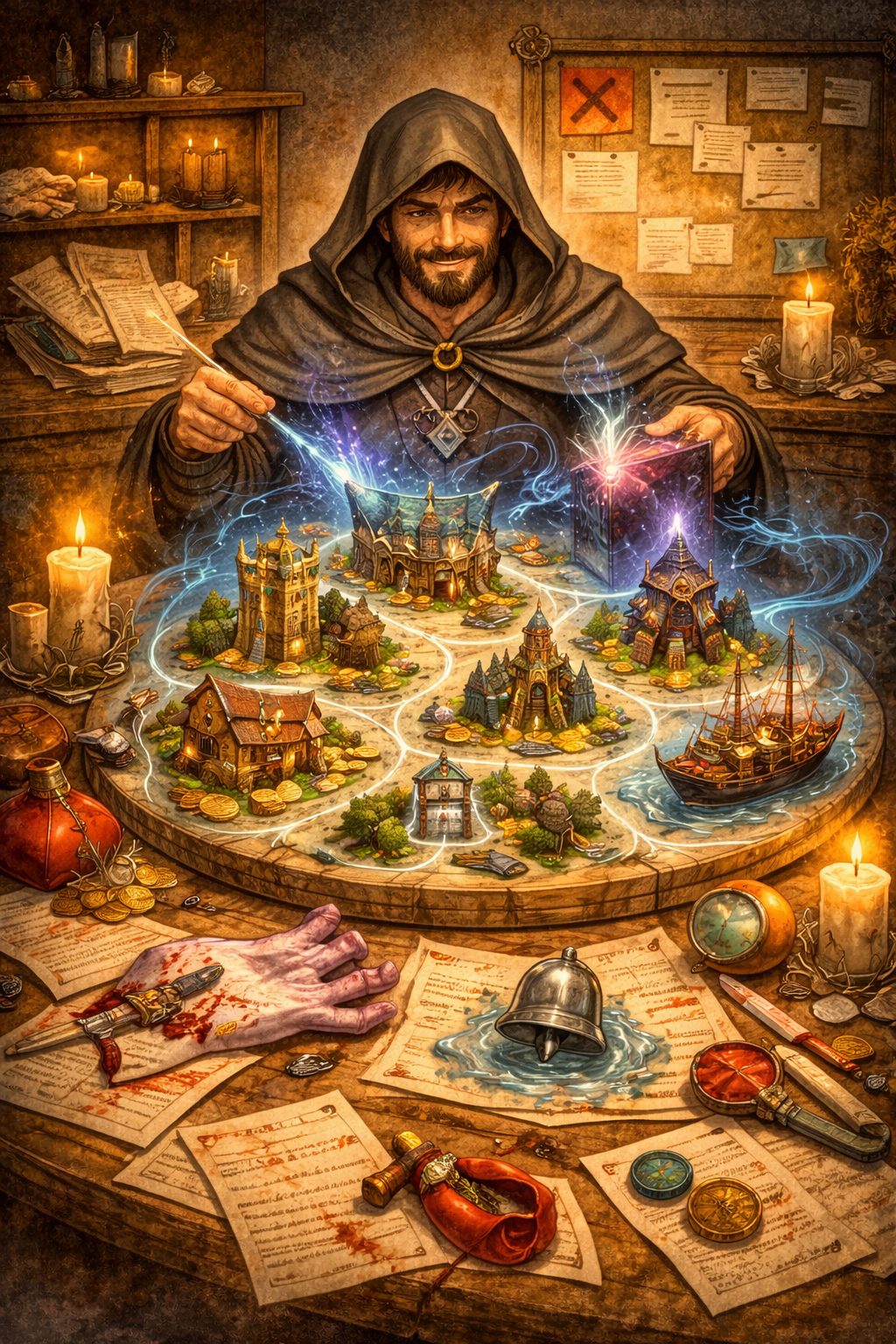
This post is about fixing that—not by becoming a flawless recall machine, but by building a DM-friendly system that turns memory into terrain. Think of it as a “Memory Palace” built specifically for tabletop play: a set of vivid anchors that let you retrieve what you forgot, improvise what you never wrote down, and keep your campaign feeling coherent even when your real-life schedule is held together with string and caffeine.
Why DMs forget (and why it’s normal)
Your brain is not a filing cabinet. It’s a prediction engine. It keeps what it thinks you’ll need, and it throws away the rest with confidence.
At the table, you’re juggling:
- rules
- pacing
- voices
- player emotions
- the next scene
- the next next scene
- and whatever goblin math you’re doing behind the screen
That’s a lot of “working memory,” the short-term mental scratch space where thoughts live before they either get stored or vanish into the void. When working memory is overloaded, details don’t stick. They don’t become “retrievable” later because they never got properly encoded in the first place.
So the goal isn’t “remember everything.” The goal is create retrieval cues: vivid, reliable handles your brain can grab later.
That’s the whole magic of the Memory Palace.
The DM Memory Palace (not the fancy ancient one)
The classic memory palace technique is about imagining a familiar location (your childhood home, a route you walk) and “placing” items in it so you can recall them by walking the space in your mind.
For DMing, we’re going to do something slightly different and far more goblin-efficient:
- We build a set of recurring campaign locations (real or imagined).
- We assign each location a category of information.
- We attach sensory “anchors” to important people, places, factions, and unresolved threads.
- We rehearse those anchors in tiny doses, right after play, so they stick.
The result: when a player asks about the duke, you don’t search your whole brain. You walk to “Nobility Hall” and look at the statue you placed there. And the name comes back (or you make one up that feels consistent because the anchor tells you what kind of duke he is).
Step 1: Build your palace out of campaign places
Pick five to seven locations that are already meaningful in your campaign. They can be literal places in the world, or “meta places” like a library, a war room, a shrine, a thieves’ den.
Examples:
- The capital city’s central plaza
- The party’s favorite tavern
- The villain’s tower
- A roadside shrine
- The ship they travel on
- The guild hall
- The weird doorway that definitely should not exist in the basement
These are your “rooms.”
Now assign each room a category:
- Tavern: NPCs and relationships
- Guild Hall: factions and politics
- Shrine: mysteries, omens, prophecies
- Road: travel beats, random encounters, recurring hazards
- Tower: villains, schemes, countdowns
- Market: items, debts, favors, resources
- Plaza: public events, rumors, consequences
You can pick different categories. When you need to recall something, you’re not searching everywhere. You’re going to the right room.
Step 2: Make anchors that are sensory, not textual
Your notes probably look like this:
“Duke Harland: corrupt, hates elves, owes money to thieves.”
That’s fine, but it’s not sticky. Your brain remembers images and emotion better than bullet points.
So we translate notes into anchors. Each anchor should include at least two of these:
- a smell
- a sound
- a texture
- a color
- a repeating phrase
- an object you can picture
For example:
“Duke Harland” becomes:
A lavender-scented glove with a wine stain, snapping shut like a book.
Now your brain has something to hold.
NPC anchors:
- The innkeeper: cinnamon breath, chipped mug, laughs like a hiccup
- The rival adventurer: wet leather squeak, silver tooth, always flipping a coin
- The archmage: cold incense, ink-stained fingers, voice like tearing paper
Faction anchors:
- The Iron Synod: a bell rung underwater
- The Red Sashes: scarlet thread wrapped around a dagger hilt
- The Ash Choir: a hymn hummed through clenched teeth
Plot-thread anchors:
- The missing crown: a cold weight behind the eyes
- The sealed door: frost spreading across iron hinges
- The demon contract: parchment that bleeds when unfolded
These anchors do two jobs: they help you remember, and they give you instant improvisation fuel.
Step 3: Use the “Three Anchors Per Session” rule
If you try to anchor everything, you’ll anchor nothing. Your brain will treat it like wallpaper.
So here’s the rule: three anchors per session.
After each game, write down:
- One NPC anchor (new or newly important)
- One location anchor (a place that mattered)
- One thread anchor (an unresolved question or looming consequence)
That’s it. Three.
Over time, those anchors create a web of recall points that pull the rest of the session back with them.
Example after a session:
- NPC: Captain Vessa: smells of rain on steel, taps a compass on her teeth
- Location: The Sunken Archive: algae lanterns, whispering shelves, cold ankle-deep water
- Thread: The Black Ledger: pages stick like tar, names written in ash
Now, six weeks later, someone mentions “that captain,” and the rain-on-steel compass-tap pulls the whole scene back into focus.
Step 4: Put your palace somewhere you can touch
Mental palaces are great, but physical cues are even better.
Pick one:
- an index card box
- a single notebook page per session
- a Notion page
- a Google Doc
- a campaign wiki
- a sticky-note wall if you’re a chaos wizard
Then format your anchors the same way every time:
ROOM (Category)
- Anchor 1:
- Anchor 2:
- Anchor 3:
Or, if you want it ultra fast:
- TAVERN: cinnamon breath innkeeper / silver-tooth coin flipper
- GUILD: underwater bell synod / scarlet thread red sashes
- TOWER: tar-sticky ledger / frost hinge sealed door
Consistency matters more than elegance.
Step 5: Add “recap cues” that train retrieval
Here’s a trick that feels like cheating: make your recaps do memory work for you.
At the start of each session, don’t recap the whole plot. Instead, do a cue recap:
- Name one anchor from last time.
- Ask the players what they remember about it.
- Add one missing detail.
Example:
“Last time, you were in the Sunken Archive—algae lanterns, whispering shelves, cold water at your ankles. What did you find there?”
Players fill in the story. Your job is to correct gently and drop the one crucial breadcrumb you need them to have.
This does three things:
- It refreshes everyone’s memory.
- It tells you what actually stuck.
- It rehearses your anchor so it stays retrievable.
At conventions or one-shots, cue recaps are still useful—just compress them into a 30-second “here’s the vibe and the objective” recap with one or two anchors so players have something to latch onto.
Step 6: Build “anchor chains” for big arcs
For longer plots, single anchors can feel like isolated islands. So you chain them.
An anchor chain is just three anchors that logically follow each other:
- Clue anchor (what points to the mystery)
- Threat anchor (what escalates it)
- Reveal anchor (what pays it off)
Example chain:
- Clue: a violin string in a sewer grate
- Threat: a masked chorus singing from alley shadows
- Reveal: a chandelier of bones above the opera stage
Now when you need to remember the arc, you can walk the chain. It’s narrative scaffolding that your brain can climb.
Step 7: When you truly forgot, improvise “true enough”
Sometimes you will not remember. It happens. The players will be staring at you like you’re a prophecy machine, and your brain will be a delightful blank.
If you remember “lavender glove with a wine stain,” you can confidently improvise:
- he’s perfumed, trying to mask something
- he’s meticulous, performing refinement
- he’s connected to vineyards, parties, or poison
- he’s hiding a spill that wasn’t wine
Then you pick a name that fits your setting, write it down immediately, and keep going.
This is not “lying.” This is collaborative continuity—the same muscle novelists use when they realize chapter 12 contradicts chapter 3 and they quietly edit chapter 3 later.
Your table will forgive an improvised detail far faster than they’ll forgive a ten-minute pause while you hunt a note you may not have written.
The convention upgrade: memory palaces for strangers
Conventions are brutal in the best way. You have a time slot, unfamiliar players, and zero shared history. Mixed experience levels are common, attention is fragile, and every minute matters.
A Memory Palace helps because it gives you:
- fast, vivid scene framing (anchors)
- clear “where are we” organization (rooms)
- a way to keep NPCs distinct without exposition (sensory cues)
For conventions, build a micro-palace:
- Room 1: The Hook (why you care)
- Room 2: The Complication (why it’s hard)
- Room 3: The Twist (why it’s weird)
- Room 4: The Climax (what must be decided)
Assign each room one anchor and one objective. That’s enough to run cleanly and rememberably in 3–4 hours.
Example:
- Hook: black rain on marble — “get inside the museum”
- Complication: golem footsteps like dropped anvils — “stop the theft”
- Twist: a lullaby played backward — “the relic is awake”
- Climax: glass shattering upward — “choose who leaves with it”
Players will remember those anchors long after the con badge is tossed in a drawer.
A quick exercise: build your palace in ten minutes
Do this before your next session:
- Write seven “rooms” (campaign places or meta-places).
- Assign each a category.
- Pick three unresolved threads in your campaign. Give each a sensory anchor.
- Pick three important NPCs. Give each a sensory anchor.
- Pick one major location. Give it a sensory anchor.
Then, right before play, read the anchors out loud to yourself once. Not dramatically—just enough to rehearse retrieval.
You are training your brain the way you train a table: through repetition with purpose.
Step 8: Use time the way your brain actually stores things
Memory isn’t saved like a document. It’s more like wet cement: it firms up over time, especially after you stop actively thinking about it. That’s why the when of your note-taking matters.
Here’s a tiny schedule that punches way above its weight:
- Within 10 minutes after the session: write your three anchors.
- Within 24 hours: reread those anchors once and add one sentence to each (“what it means” or “what it threatens”).
- About a week later (or before the next session): skim the last two sessions’ anchors. That’s it.
You’re not trying to memorize. You’re just giving your brain a gentle, repeated tap on the shoulder: “Hey, this matters.”
If you run weekly games, that “week later” skim is basically free: it becomes your pre-session warmup. If you run monthly games (or life ambushes your schedule), it’s even more important—because your brain will happily replace your duke’s name with the name of a coworker you saw once in 2019.
Step 9: Turn anchors into “memory artifacts” your players can see
The best memory is shared memory. If the table holds the information, you don’t have to carry it alone.
Try making one or two anchors player-facing each session:
- Put a faction anchor on a little tent card (“the bell rung underwater”) and leave it on the table when they deal with that group.
- Drop an image or short phrase into your VTT as a handout (no lore dump—just the anchor).
- Give an NPC a physical prop: a wax-sealed note, a coin with a bite mark, a ribbon that smells faintly of smoke.
These artifacts do something sneaky: they act as retrieval triggers for everyone. When a player says, “I still have the coin with the bite mark,” your whole table just refreshed that NPC without you lifting a finger.
Step 10: The graceful recovery when you still blank
Even with a palace, sometimes the name is gone.
When that happens, don’t apologize like you committed a crime against storytelling. Use a smooth “continuity move”:
- Restate the anchor. “The lavender-glove duke.”
- Ask a player for the last known fact. “What did he promise you?”
- Fill the gap with a consistent detail and write it down. “Right—Duke Harland. He promised letters of marque.”
You’ve converted a memory failure into a collaboration beat. The game stays in motion, the players feel involved, and you quietly patch the lore behind the scenes.
That’s the DM’s real superpower: not perfect recall, but perfect recovery.
Your memory will never be perfect—and that’s fine
The secret is that your players don’t want you to be a database. They want you to be a storyteller who keeps the world feeling alive.
A Memory Palace doesn’t make you perfect. It makes you consistent. It makes you faster. It gives you confidence when you improvise. It turns “I forgot” from a panic moment into a gentle pivot: you step into the right room, touch the right anchor, and the rest of the scene follows.
And if the duke’s name still doesn’t come back? Give him a new one, let the lavender glove snap shut, and keep the adventure moving.
Until next time, Dear Readers...