Paperwork Dungeons: Bureaucracy, Permits, and the Quest for Legal Access
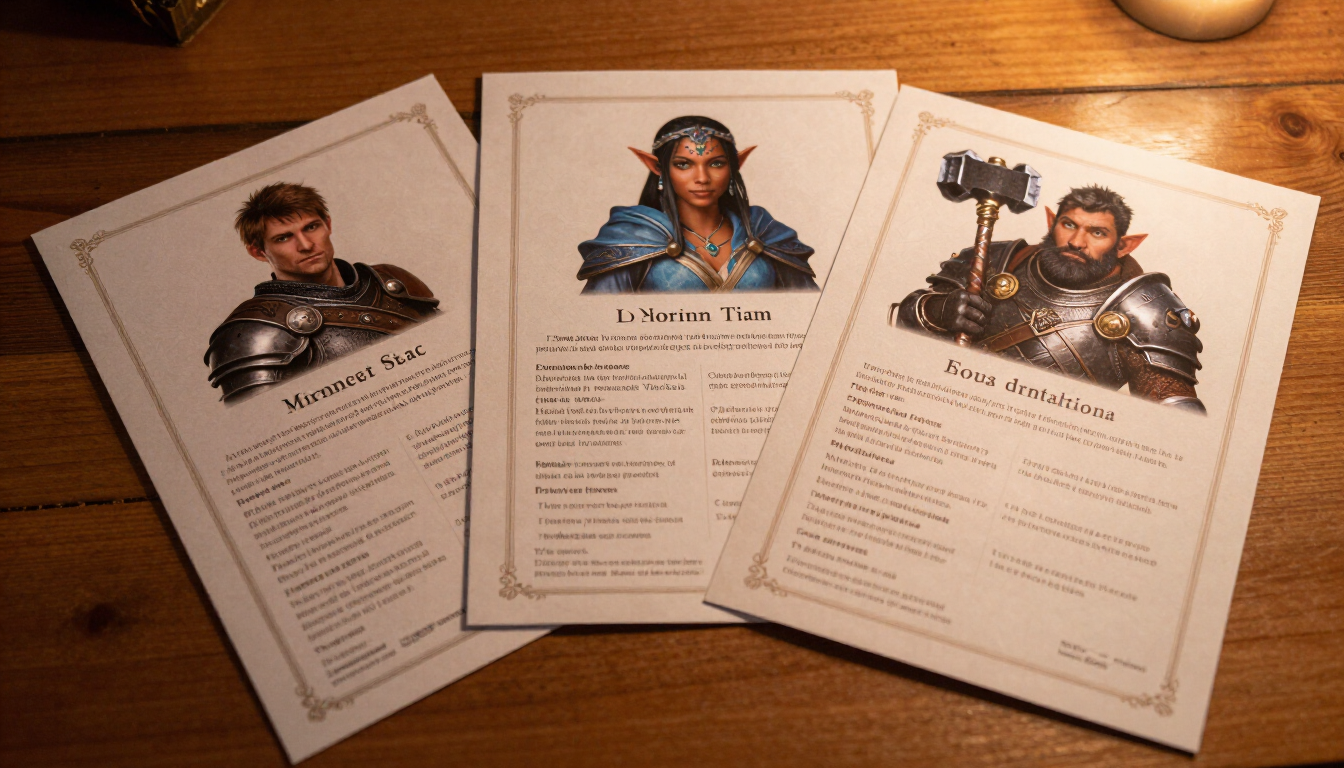
I'll need it in triplicate, each stamped With a Noble's Crest, and one of the copies sealed with a magistrate's Approval
Dear Readers,
Somewhere out there, a dragon is sitting on a hoard of gold, and a party of adventurers is about to kick in the door and say, “We’re here to negotiate with violence.”
But in your campaign, the dragon isn’t the first obstacle.
The first obstacle is Form 7B.
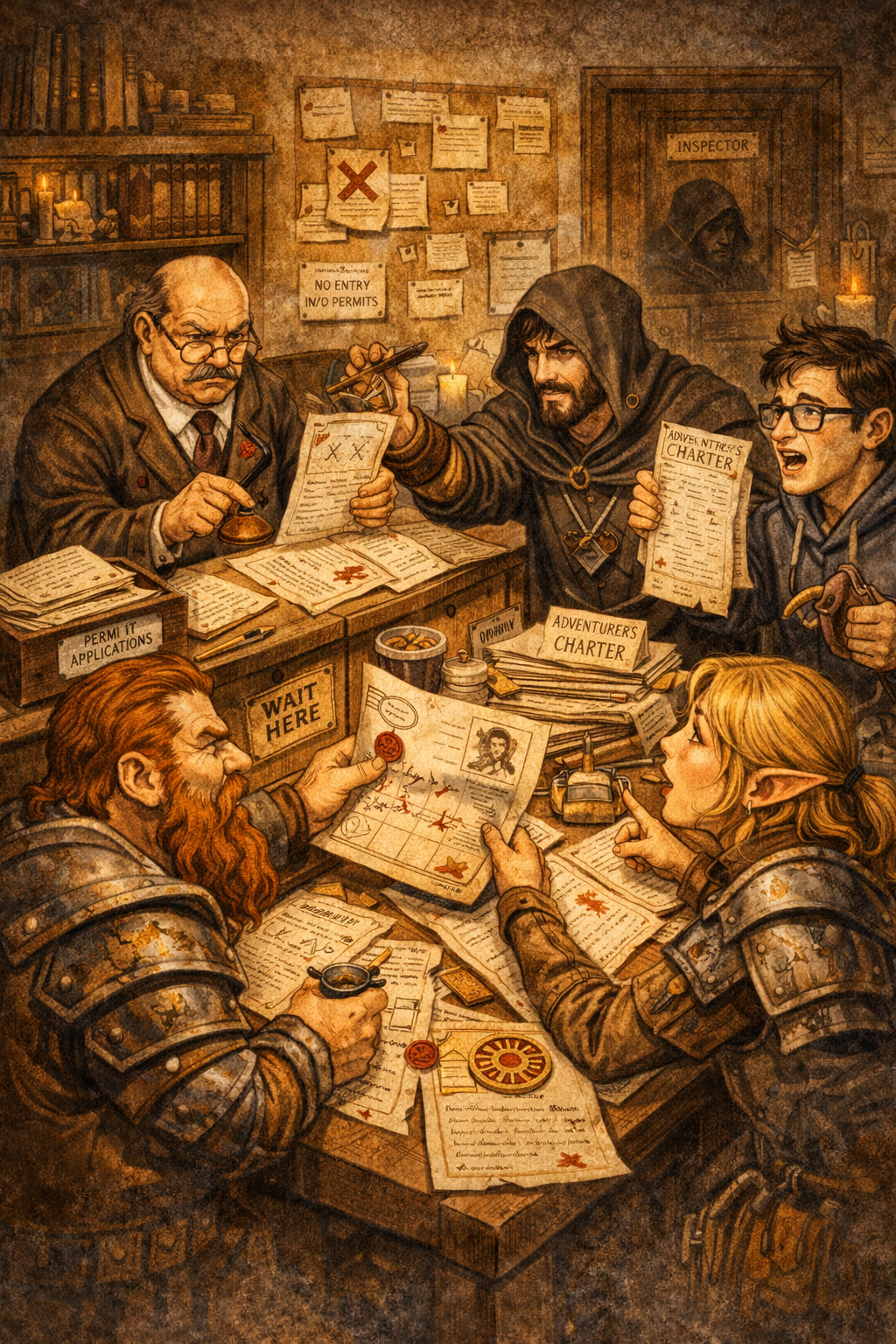
Because the city has laws. The kingdom has borders. The guild has standards. The temple has rules. The ship’s captain won’t take “trust me, bro” as proof you’re allowed to carry a greataxe onto a ferry. The archivist won’t let you touch the sealed scroll unless you’re certified, sponsored, or at least wearing the correct robe.
And here’s the thing: this can be incredibly fun.
If you run bureaucracy like a boring delay, it will be boring. If you run it like a dungeon (I use that term loosely as it can apply to any TTRPG setting), it becomes one of the most flavorful, flexible, and surprisingly tense kinds of play you can drop into a tabletop RPG, especially when you need social encounters that feel structured, high-stakes, and winnable without stabbing anybody (though the option to stab someone is always vibrating nearby like a cursed tuning fork).
This post is about turning permits, paperwork, procedures, and petty officials into a playable “social dungeon,” that is, a Paperwork Dungeon, with clear challenges, multiple routes to success, and rewards that matter.
We’ll build it as an engine you can reuse in any system, and we’ll make sure it supports different table styles: roleplay-forward groups, tactical planners, chaos gremlins, and the people who genuinely enjoy reading the fine print like it’s a dragon’s true name.
Why bureaucracy works as an adventure structure
A dungeon is not “a place with rooms.” A dungeon is a sequence of obstacles that the party must overcome, each draining or rewarding resources, each offering choices, each building tension toward a payoff.
Bureaucracy is already structured like that. It has:
- gatekeepers (clerks, inspectors, librarians, captains, magistrates)
- locks (forms, seals, approvals, signatures)
- traps (deadlines, hidden fees, contradictory rules)
- wandering monsters (auditors)
- environmental hazards (lines, waiting rooms, office hours)
- puzzles (which office handles this? which stamp is correct?)
- loot (permits, writs, passports, licenses, charters, sealed letters)
And unlike a combat dungeon, it can be run in almost any tone:
- comedic (“the clerk insists you fill out the form in blue ink”)
- noir (“the permit office is a front for a smuggling ring”)
- political (“the law is designed to keep certain people out”)
- heroic (“you’re changing a system by outmaneuvering it”)
- horror (“the paperwork is alive and remembers your lies”)
Most importantly: bureaucracy gives you stakes without violence. That’s useful in conventions, mixed-skill tables, and any campaign where you want tension that isn’t “roll initiative.”
The DM’s prime directive: make it a challenge, not a wall
Players accept obstacles. They hate walls.
A wall says: You can’t proceed until you guess what I want.
A challenge says: There are multiple ways through this, and your choices matter.
So build your Paperwork Dungeon with three viable routes (minimum) and let the players discover which one fits their style.
I like a simple, reusable framework:
The Three Doors Framework: Bribe / Prove / Outmaneuver
Every bureaucratic barrier should have at least three ways to bypass it:
- Bribe (or pay): gold, favors, gifts, “expedite fees,” donations, blackmail, patronage
- Prove (legit): credentials, references, tests, evidence, compliance, paperwork done properly
- Outmaneuver (clever): loopholes, alternate authority, social leverage, disguises, back doors, allies, timing
You can rename these to match your setting’s vibe, but the core remains: money, legitimacy, cunning.
When players feel they have three doors, they feel agency. Even if two doors look hard, they know the third exists.
Step 1: Decide what “legal access” unlocks
Paperwork must matter, or it’s just a skit.
Pick one thing the permit/authorization unlocks that players actually want:
- entry to a restricted district
- access to a sealed archive
- permission to carry weapons in the city
- license to hunt a monster (and collect bounty)
- charter to explore ruins on crown land
- permission to sail during a blockade
- right to interrogate suspects
- ability to requisition supplies
- authority to cross borders without inspection
- exemption from curfew
- membership in a guild that gives discounts, contacts, downtime options
Then make sure the unlocked thing pays off quickly. If the party spends a whole session acquiring a writ, and then you don’t use it for three sessions, the writ feels fake. Use it within the next session, even if it’s small—guards salute, a door opens, an archivist hands over a box, someone treats them differently.
Paperwork is social treasure. Let it sparkle.
Step 2: Turn the process into “rooms” and “encounters”
A Paperwork Dungeon works best when it has a clear path and clear beats. You don’t need a spreadsheet. You need three to six scenes that feel like progress.
Here’s a standard template you can reskin endlessly:
- The Entry Hall: you learn the requirements (and the first contradiction)
- The Gatekeeper: the clerk/guard/librarian who enforces policy
- The Missing Piece: you lack one document, reference, or stamp
- The Alternative Authority: another office/figure can override or fast-track
- The Audit/Inspection: someone checks your story, gear, or records
- The Stamp of Victory: you get the permit—then a complication reveals itself
Not every dungeon needs all six. But having “rooms” helps you pace it, and helps players feel like they’re moving.
Paperwork Encounters should drain resources
Not hit points—resources the party cares about:
- time (deadlines, travel, office hours)
- money (fees, bribes, donations)
- reputation (favors owed, suspicion raised)
- inventory (confiscated items, required equipment)
- social capital (using up contacts)
- spell slots (divinations, charm effects)
- stress/conditions (in some systems)
If nothing is spent, nothing is at stake. If everything is blocked, it feels unfair. The sweet spot: players spend resources by choice to buy certainty and speed.
Step 3: Make time matter (without bogging down)
Bureaucracy is only dramatic when there is pressure.
Add one of these clocks:
- Office hours: “Closes at sundown.”
- Deadline: “You need the writ before the execution tomorrow.”
- Competition: “Another party is applying for the same charter.”
- Escalation: “After three days, the guards search every traveler.”
- Event: “The council meets in two hours; after that, no exceptions.”
Clocks prevent infinite debate and make choices crisp. You don’t need to shout “clock," just make the world react.
The cast: bureaucrats you can run like monsters
A good Paperwork Dungeon lives or dies on its NPCs. Think of them like monsters with stat blocks—just social ones.
Here are five “bureaucrat types” you can drop in quickly:
1) The Rule Paladin
They follow policy with religious intensity. Not evil. Just immovable.
Weaknesses:
- higher authority
- exact compliance
- precedent (“last year you allowed this”)
- public scrutiny
- being shown that they are out of compliance
2) The Tired Gatekeeper
They’ve seen everything. They want the line to move. They are not paid enough.
Weaknesses:
- empathy
- shortcuts that reduce work
- snacks (yes, snacks)
- someone else taking the blame
- a story that feels true
3) The Corrupt Opportunist
They see permits as income. They will “help” for a price.
Weaknesses:
- exposure
- competition (someone else offers a cheaper bribe)
- a bigger fish who dislikes freelancing
- blackmail
4) The Petty Rival
They don’t hate the party. They hate being disrespected. They enjoy control.
Weaknesses:
- flattery
- status
- rules-lawyering them back
- humiliating them socially (careful with this)
- giving them a win that costs you little
5) The Hidden Ally
They are stuck in the system but want to help—quietly.
Weaknesses:
- fear of being seen helping
- needing plausible deniability
- a favor owed
You can run these like combat encounters. Players identify the type, adapt tactics, exploit weaknesses, spend resources.
That’s gameplay.
The paperwork as puzzle: make forms into clues
If you want the Paperwork Dungeon to feel like a mystery, bake information into the bureaucracy.
Examples:
- A permit form includes a list of “restricted zones”—one is crossed out in old ink. Why?
- A weapon license requires you to name a “responsible party” who can vouch for you. That NPC becomes relevant.
- A border pass asks for “last place of residence.” The party realizes the villain’s agents all list the same false address.
- A shipping manifest reveals where contraband is moving.
- A library access ledger shows who read the forbidden tome last month.
Bureaucracy is documentation. Documentation is evidence. Players love evidence.
The Four Classic Paperwork Dungeons (and how to run each)
Let’s build four ready frameworks you can reuse forever.
A) The City Weapons Permit
Goal: carry weapons legally, avoid confiscation/fines/arrest.
Rooms:
- Gatehouse inspection (guards list requirements)
- Permit office (clerk explains categories: blades, bows, spell foci)
- Assessment (prove training or join a guild)
- Issuance (stamp + visible permit token)
Twists:
- the permit is tiered (common, martial, arcane)
- permits are limited; there’s a waiting list
- the city is under threat, rules are changing daily
Ways through:
- Bribe: “expedite fee” or donation to the Watch Widows Fund
- Prove: demonstrate skill; provide references; join a recognized guild
- Outmaneuver: get a noble writ; carry concealed; store weapons at a bonded inn and retrieve later
Rewards:
- guard respect
- reduced harassment
- access to armories and training yards
- legal authority in certain situations
B) The Archive Access Writ
Goal: consult restricted records or a sealed tome.
Rooms:
- Public library (learn of restricted collection)
- Archivist interview (they test your purpose)
- Sponsorship (need a temple seal, university letter, or noble patron)
- Handling protocol (gloves, warded reading room, supervisor present)
Twists:
- the restricted text is dangerous (cursed knowledge)
- someone else has been reading it, leaving traces
- the archive is being quietly censored
Ways through:
- Bribe: rare book donation; restoration funding
- Prove: research proposal; credentials; oath of responsibility
- Outmaneuver: talk to the night custodian; use a rival’s letterhead; find a loophole (“as part of an inquest…”)
Rewards:
- forbidden lore
- faction reputation
- leverage (knowledge is power)
C) The Border Crossing Charter
Goal: cross a border during tension, quarantine, or war.
Rooms:
- Checkpoint (requirements and suspicion)
- Customs (inventory declaration, inspections)
- Permit authority (captain/magistrate)
- Escort or bond (someone guarantees your behavior)
Twists:
- the border is a smuggling hotspot
- the permit system is being used to discriminate
- a plague or magical contamination complicates everything
Ways through:
- Bribe: cargo “donation,” escort fee
- Prove: official papers, trade license, noble seal
- Outmaneuver: cross at an old ford, disguise as merchants, leverage a rival faction’s authority
Rewards:
- access to new region
- reputation with border factions
- potential smuggling intel
D) The Adventuring Charter (Guild License)
Goal: get “legal adventurer” status with rights, bounties, and protection.
Rooms:
- Guild hall intake (paperwork and fees)
- Background checks (references, criminal record, past deeds)
- Trial (practical test, team exercise, ethics scenario)
- Oath and issuance (license token, charter, terms)
Twists:
- guild politics: someone blocks them
- rival team tries to sabotage the trial
- the guild is secretly corrupt or compromised
Ways through:
- Bribe: sponsor a guild project, fund repairs, donate loot
- Prove: pass trials, show prior heroics, earn a patron
- Outmaneuver: secure a provisional charter via emergency, expose a corrupt official, get a noble to demand licensing
Rewards:
- bounty rights
- discounts
- access to jobs board
- safehouses and healing services
- legal protection from being labeled “bandits”
These frameworks can carry entire sessions, especially if you tie them to a ticking clock.
The “social dungeon” combat rules: initiative without calling it initiative
Some tables get chaotic in social scenes. One person talks, others drift. The loudest player becomes the “face” by default. A Paperwork Dungeon is a perfect place to use structured turns without making it feel like a courtroom drama simulator.
Try “conversation rounds”:
- Each player gets one meaningful action per round: ask, present evidence, charm, intimidate, bribe, research, observe, assist.
- The NPC reacts after each round, moving closer to approval or denial.
- After 2–3 rounds, a complication enters: a supervisor arrives, a rival interrupts, the office closes soon.
This keeps everyone engaged, gives shy players a lane, and makes the scene feel like a game instead of improv theater.
At conventions, this structure is a lifesaver. It also makes the bureaucratic scene feel tense and tactical without needing combat.
The best reward: paperwork as treasure (make it loot)
If you want players to care about bureaucracy, treat the result like an artifact.
Examples of “social loot”:
- a stamped travel pass that bypasses checkpoints
- a sealed letter of authority
- a guild badge that grants lodging and legal status
- a legal title (“Deputy Inspector of the Watch”)
- a letter of marque permitting privateering
- a temple indulgence or holy sanction
- a writ of salvage rights
- an exemption from a local taboo
Represent it physically when possible: a token card, a seal graphic, a physical prop. If you play online, make it a handout. When it has form, it feels real.
Then use it. Let it open doors. Let it trigger reactions. Let it create obligations. That’s how it becomes part of the campaign’s living economy.
Complications: the “wandering monsters” of paperwork
Every good dungeon needs wandering monsters. Bureaucracy has them.
Here are complications you can drop in as pacing tools:
- The Auditor: demands to see receipts, documentation, proof of identity
- The Supervisor: the clerk’s boss arrives and changes the rules
- The Rival Applicant: another party is applying for the same permit
- The Missing Stamp: the form is complete except for the one seal only available across town
- The Fee Increase: emergency surcharge, “security tax,” “restoration levy”
- The Queue: the line is hours long unless you find a back door
- The Contradiction: two offices have different requirements; only a third authority can reconcile them
- The Bribery Sting: someone is watching for corruption
- The Office Politics: the helpful clerk is punished if they help too openly
- The Sudden Event: riot, curfew, storm, fire—office shuts down
Complications are not punishments. They are movement. They make the system feel alive and keep the scene from becoming a static negotiation.
Ethics and tone: bureaucracy can be funny without being cruel
Bureaucracy is a real-world stressor. Some players have lived through systems that were unfair, discriminatory, or oppressive. If you play it as “lol paperwork,” that can be fun—unless it hits too close to home.
A good rule: aim your satire upward. Make the system ridiculous because of power, pride, corruption, and incompetence at the top—not because ordinary people are dumb.
Also, keep the players’ agency intact. Bureaucracy should feel like a puzzle with multiple solutions, not like a reminder that the world is unfair and they can’t do anything about it.
If you do want to explore injustice as a theme, do it intentionally, with safety tools, and make sure players have meaningful ways to resist and change the system. Nothing feels worse than “the world is bad, and you can’t do anything.” A heroic campaign should allow heroism.
The secret sauce: bureaucracy creates story consequences automatically
Combat consequences are obvious: bodies, wounds, loot. Paperwork consequences are quieter and sometimes more powerful.
When the party gets a permit:
- their names enter records
- factions can track them
- rivals can request copies
- corrupt officials can sell information
- laws can be turned against them later
- allies can cite their legitimacy
When the party bypasses the system:
- they gain speed
- but risk being labeled criminals
- and create enemies among gatekeepers
- while earning respect from smugglers and rebels
This is delicious. Your world becomes reactive without you needing to script dramatic twists. The permit itself is a thread you can tug later.
A complete one-session Paperwork Dungeon you can run tonight
Here’s a plug-and-play scenario skeleton.
Premise: The party needs access to the “Night Ledger,” a restricted record held in the city’s Hall of Accounts. The ledger contains proof that a noble is funding kidnappers. The problem: only licensed investigators can access it, and the office closes at sundown.
Room 1: The Entry Hall (10–15 minutes)
The party arrives. A guard checks for credentials. They learn:
- Access requires a stamped writ from either the Watch Captain or a Magistrate.
- Alternatively, a guild investigator badge grants access.
- The office closes at sundown. It is mid-afternoon.
Tells:
- The guard mentions “new rules since last month.”
- The posted requirements have been amended in a different ink.
Room 2: The Permit Office (15–25 minutes)
A clerk explains the process. They need:
- proof of identity
- a sponsor
- payment of a processing fee
- and a short statement of purpose (filed permanently)
The clerk is tired but not unkind.
Options appear:
- Pay the fee and wait (too slow)
- Fast-track via sponsor
- Obtain an emergency writ
Room 3: The Sponsor Hunt (20–40 minutes)
The party chooses how to get authority fast:
- convince the Watch Captain (social challenge)
- persuade a Magistrate (legal argument)
- leverage a guild contact (favor owed)
- bribe a lesser official (risk)
- forge a seal (skill and danger)
Each path is a mini-encounter:
- Watch Captain wants proof and a promise
- Magistrate wants a written petition and witnesses
- Guild wants a cut of credit or loot
- Bribe risks an auditor
- Forgery risks magical seal verification
Room 4: The Audit (10–20 minutes)
As they return, an auditor is checking documents. The party must:
- present paperwork in correct order
- answer a question about their purpose
- avoid contradicting themselves
If they’re legit, they pass.
If they’re bending rules, they can still pass with cleverness or sacrifices.
Room 5: The Reading Room (10–20 minutes)
They gain access. The ledger is warded. They must:
- follow handling rules
- copy quickly
- and notice: pages have been removed recently
Twist:
- Someone else is already trying to erase evidence. A chase or confrontation can follow, or a race against time to copy the proof.
Loot:
- access token (temporary)
- a stamped receipt that proves they were there
- names of witnesses in the ledger
- and a new enemy who now knows the party can play the “legal game”
That’s a whole session with tension, choices, and payoff—no combat required unless the party chooses it.
Convention note: why Paperwork Dungeons shine at cons
Con tables are mixed-skill tables by default. You want scenarios that:
- teach the game loop quickly,
- give every archetype something to do,
- and create stakes without requiring deep rules mastery.
Paperwork Dungeons do this beautifully because they’re naturally modular:
- the roleplayers get negotiation scenes,
- the tacticians get structured “rounds” and clocks,
- the investigators get evidence,
- the chaos gremlins get loopholes and schemes,
- and newbies get clear options (“bribe, prove, outmaneuver”).
Also: bureaucratic scenes create instant table cohesion. Strangers love teaming up against a common enemy, and few enemies are as universally understood as “the office closes in ten minutes and the clerk is on break.”
A toolbox of quick paperwork items you can drop as loot
Here are some ready “paper treasures” you can hand out:
- Writ of Temporary Passage (expires in 7 days; bypasses one checkpoint)
- Guild Charter: Provisional (access to jobs board; requires one job completed)
- Letter of Marque (legal privateering against named faction; political consequences)
- Salvage Rights Token (claim to recovered shipwreck goods; contested by others)
- Archive Access Seal (one day in restricted stacks; monitored)
- Deputy Badge (authority to investigate crimes; must file reports)
- Temple Sanction (permission to bear holy arms; expects conduct)
- Quarantine Exemption (dangerous if discovered; requires proof of immunity)
- Safehouse Voucher (one night of discreet lodging; favors owed)
- Bonded Carry Permit (carry one restricted item if sealed and logged)
Each one is a hook. Each one is leverage. Each one is an invitation for consequences.
Final advice: keep it brisk, keep it human, keep it winnable
The moment bureaucracy becomes a slow-motion gag, it stops being a dungeon and starts being a delay. So:
- Keep scenes short and purposeful.
- Give players clear choices.
- Make officials human, not caricatures.
- Reward cleverness and verification.
- Let the paperwork unlock something real.
- And always—always—let the wrong turn still give story.
Because in the end, the Paperwork Dungeon is not about forms.
It’s about power. It’s about access. It’s about who gets to go through the door.
And it’s about the party learning that sometimes the scariest thing in the world isn’t a lich.
It’s a clerk with a stamp, a deadline, and a deeply held belief that you filled out the wrong box.
Until next time, Dear Readers...