The Surrender Button: Morale, Rout, and Ending Combat Before the Slaughter
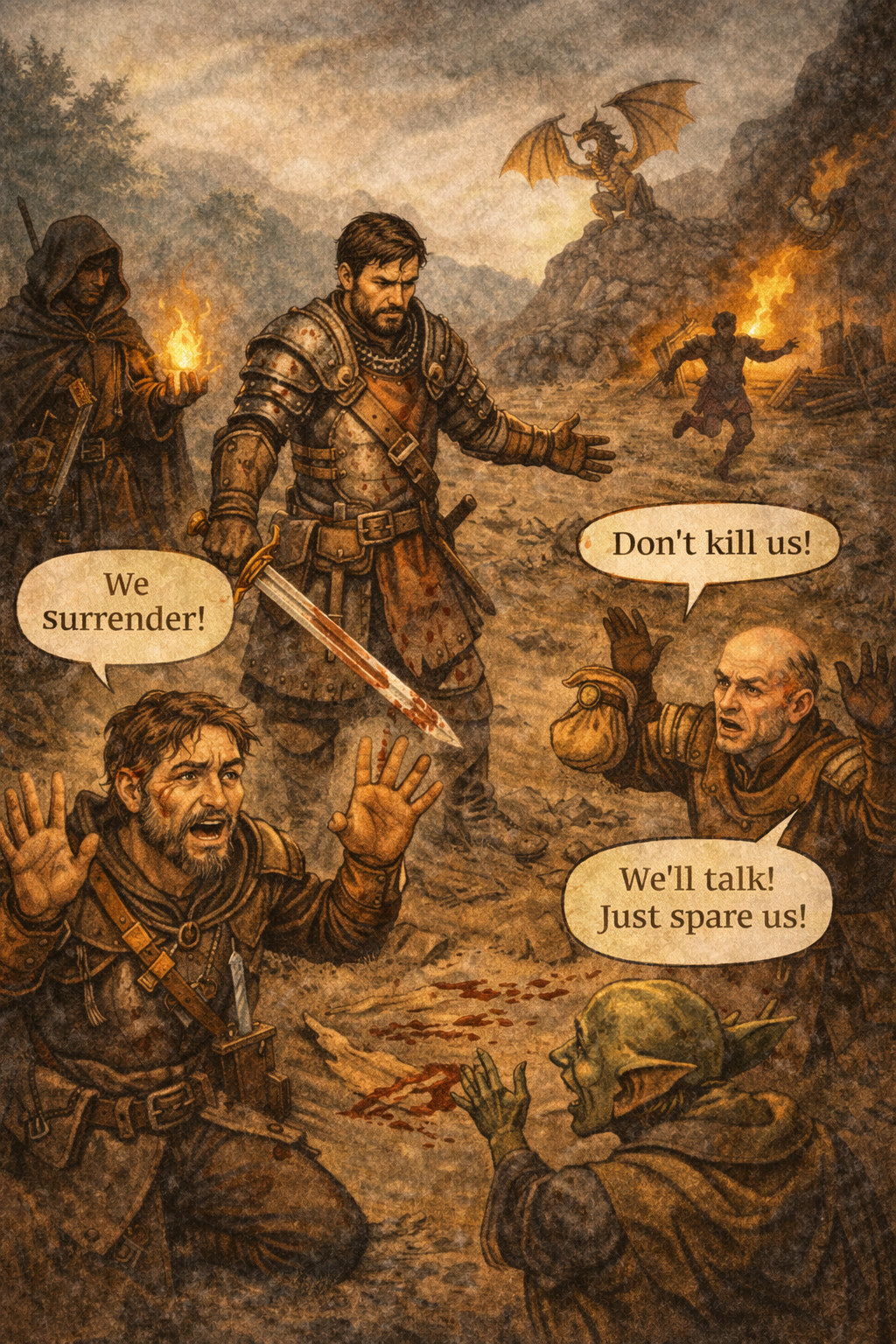
Don't Shoot, I Give UP!
Dear Readers,
Most D&D combats end the same way: the last hit lands, the last enemy drops, and the battlefield goes quiet except for the party immediately asking, “So… loot?”
It works. It’s familiar. It’s clean.
But it’s also weird.
Because in most actual fights—historical skirmishes, bandit ambushes, street brawls, even battles between disciplined troops—people don’t typically fight to the last body. Most creatures (and most people) like being alive. They surrender. They flee. They bargain. They throw down weapons and plead. They pretend to yield and then bolt. They panic. They rout. They break.
When you build a “Surrender Button” into your encounters, combat becomes less of a hit point grind and more of a living scene with shifting stakes. Players get new choices: do we accept surrender? take prisoners? negotiate mid-fight? let them run? chase? show mercy? be terrifying?
Suddenly combat isn’t just damage math. It’s consequence math.
And the best part: this makes your game feel more heroic, more tactical, and more morally interesting—without needing you to change the system much at all.
This post will give you an easy morale procedure you can drop into D&D 5e (or most fantasy TTRPGs), plus the practical DM tricks that keep it fun: how to trigger morale, how to telegraph it, how to reward it, how to stop surrender from becoming a loophole for every villain, and how to use rout and prisoners as story fuel instead of paperwork drudgery. (Yes, I know what I just did there.)
Why combats drag (and why morale fixes it)
Long combats usually happen for one or more reasons:
- Too many bodies on the field with similar durability.
- No changing objective (“kill them all” is the only win condition).
- No reason to stop (enemies fight like mindless robots).
- Players optimize for damage, not decision points.
- Enemies have no fear because they are written as static stat blocks.
Morale introduces a different kind of countdown: not “when do they hit 0 HP,” but “when do they stop believing they can win?” It creates an off-ramp. It also creates narrative realism and tactical texture: enemies behave differently when desperate.
A goblin ambush is scarier when the goblins might scatter, leaving behind a few who surrender and start talking. A bandit captain is more interesting when he tries to cut a deal at half health.
A cultist is creepier when they refuse to rout… until their faith shatters.
Morale is the combat equivalent of a good social scene: there’s a turning point.
A quick definition: morale, rout, and surrender
Let’s separate terms so your table doesn’t get confused:
- Morale: the willingness to continue the fight.
- Rout: a morale collapse that triggers an attempt to flee, scatter, or disengage.
- Surrender: an attempt to stop the fight by submitting to the opponent’s terms.
- Break point: the moment you roll or decide morale.
In D&D terms, morale is not a condition on the character sheet. It’s a DM-facing procedure that creates believable behavior and shortens combats in a satisfying way.
The Surrender Button philosophy: “monsters want something”
Morale only makes sense if enemies have motivations. “Evil” isn’t a motivation; it’s a label.
Ask: what does this group want?
- money
- safety
- territory
- recognition
- a hostage exchanged
- time for the ritual
- a chance to escape with the artifact
- a public display of dominance
- revenge
- to impress a boss
When enemies want things, they can decide they’ve gotten enough, or that continuing is too costly. That’s where surrender and rout live.
This also helps you avoid the classic problem: “Every enemy surrenders at the first sign of trouble, so combat never happens.” If they want something, they’ll fight until they either achieve it or realize they can’t.
The simplest morale system that actually gets used
If morale rules are complicated, they won’t survive contact with your DM brain during initiative. So here’s the one I recommend for D&D tables because it’s fast, flexible, and easy to remember.
The Two-Number Morale Check
Every enemy group has:
- Morale DC (how hard they are to break)
- Morale bonus (how disciplined or fanatical they are)
When a break trigger happens, the group makes a morale check:
- Roll d20 + morale bonus vs Morale DC
- Success: they hold (for now)
- Failure: they break—either rout, surrender, or bargain depending on circumstance
That’s it.
Quick defaults
If you don’t want to assign numbers, use these:
- Cowardly rabble: DC 10, bonus +0
- Regular toughs: DC 12, bonus +1
- Trained soldiers: DC 14, bonus +2
- Elite/zealots: DC 16, bonus +3
- Fanatics/undead-hardened: DC 18, bonus +4
Or even easier: set DC equal to 10 + CR for small groups, add +2 if disciplined.
The numbers matter less than the habit: you’re creating break points.
Break triggers: when to press the button
Morale checks shouldn’t happen every round. They should happen at turning points.
Use a small list of triggers. Pick 2–4 per encounter.
Reliable morale triggers
- The group loses its leader (killed, captured, or obviously routed).
- The group hits half its members down (or half total HP down).
- The group is hit by a terrifying effect (fireball, dragon breath, divine wrath).
- An enemy is reduced to 0 HP in one hit (dramatic demonstration).
- The group is outflanked or cut off from escape.
- A key objective is lost (artifact stolen, hostage freed, ritual disrupted).
- The party presents a credible threat (“drop weapons or you die”).
Special trigger for “animals and predators”
Animals rarely fight to the death unless cornered or protecting young. A predator that takes a big hit often tries to flee. Use:
- “First serious wound” (down to 2/3 HP)
- “Prey becomes dangerous” (PCs show lethal resistance)
Special trigger for “fanatics”
Fanatics don’t break easily… but they might break differently:
- They might fight to the death until their faith symbol is destroyed.
- They might rout when their prophet is proven false.
- They might surrender if offered a chance to “live to serve the cause.”
Fanatics aren’t immune to morale. They just have different levers.
Telegraphing morale: make it readable in the fiction
Players feel cheated when enemies surrender “out of nowhere” because the DM wants to end combat. Make morale visible so it feels earned.
Use tells:
- “Their eyes dart to the door.”
- “The bandit’s voice cracks.”
- “Two goblins start backing away.”
- “The cultist’s chant stumbles.”
- “The captain is shouting orders but no one’s listening.”
You can even describe a “morale bar” without calling it that:
“They’re fighting hard, but you can feel it—this group is seconds away from breaking.”
Telegraphing creates tactical play. Now the party can choose to press the advantage with intimidation, capture, or negotiation.
The three outcomes of a failed morale check
When the group fails morale, don’t default to “they all run.” Choose an outcome that fits their goal and situation.
1) Rout: “Every goblin for itself”
Use rout when:
- escape is possible
- cohesion is weak
- leader is gone
- they were never committed
Rout behavior:
- Disengage, dash, scatter
- Drop heavy gear
- Leave wounded behind
- Try to flee to a known safe spot
Rout creates chase scenes, ambush opportunities, and consequences like “they warn the next camp.”
2) Surrender: “We yield!”
Use surrender when:
- escape is hard
- they believe the party will spare them
- they have something to bargain with
- they are disciplined enough to submit
Surrender behavior:
- Drop weapons
- Hands visible
- Offer information, hostage, or goods
Surrender creates prisoners, intel, moral choices, and legal consequences.
3) Bargain: “We can make a deal”
Use bargain when:
- the enemy is intelligent and self-interested
- they still have leverage (hostage, info, escape route)
- they believe the party wants something
Bargain behavior:
- Talk while retreating
- Offer terms
- Stall for time
Bargain creates mid-combat roleplay—one of the best kinds of play because it’s charged with danger.
Rewarding mercy without making it “optimal abuse”
If you add surrender, players will try to exploit it. That’s normal. The trick is to reward mercy and restraint without turning every encounter into “farm prisoners for XP.”
Here are rewards that feel good and don’t break your game:
Information rewards
Prisoners talk—sometimes truthfully, sometimes not. But even lies are clues.
- “The captain’s camp is north.”
- “There’s a tunnel behind the shrine.”
- “The baron pays us in silver with a wolf stamp.”
- “We were told not to kill you—only delay you.”
Reputation rewards
Merciful parties gain reputations:
- locals trust them
- enemies fear or respect them
- some factions offer support
- others see them as “soft” and test them
Resource rewards
Accepting surrender can save:
- hit points
- spell slots
- time
- ammunition
- risk of death spirals
This is a natural reward: ending combat early is itself a payout.
Moral rewards (the good kind)
Mercy can create recurring NPCs, redemption arcs, and the feeling that the party’s choices matter beyond loot.
But do keep consequences real. Mercy doesn’t mean “no risk.” It means “different risk.”
Handling prisoners without turning your session into Prison Transport Simulator
Players will ask: “What do we do with them?”
You want a simple procedure that doesn’t derail the adventure.
Here are three clean options:
Option A: The “turn them over” pipeline
If the party has legal authority (guild charter, deputy badge, etc.), they can deliver prisoners to the Watch, a temple, or a patron.
This is clean, fast, and feels like the world has institutions. It also creates interesting consequences: corrupt guards might release them, or the enemy might escape later.
Option B: The “bind and leave” option
The party binds prisoners, removes weapons, and leaves them with a chance to survive.
Consequence:
- they might escape
- they might die
- they might become future allies/enemies
This is fast and morally gray—perfect for gritty games.
Option C: The “prisoner as complication” option
If you want it dramatic, treat prisoners as a moving complication:
- they slow travel
- they attract rescue attempts
- they provide info
- they might betray the party
Use this sparingly. It’s great for one session, not every session.
A simple prisoner rule that keeps it sane
If the party wants to keep prisoners long-term, ask them for one logistical commitment:
- “Who is guarding them?”
- “What are you feeding them?”
- “Where are you taking them?”
- “What stops them from escaping?”
If they can’t answer, the world pushes back. Not as punishment—just as physics.
Villains and surrender: when the big bad should (and shouldn’t) yield
A common worry: “If enemies can surrender, does every boss surrender at 10 HP?”
Not if you define villain motivations and stakes.
Bosses typically:
- have pride
- have a plan
- have a reputation to maintain
- have something worse than death waiting if they fail
- have escape contingencies
So bosses might:
- withdraw rather than surrender
- bargain from a position of leverage
- fake surrender as a tactic
- fight to the death if captured means torture or disgrace
- surrender only if it advances a later plan
Let villain surrender be rare and meaningful. When it happens, it should feel like a dramatic turn in the story, not a combat cleanup step.
The villain’s “surrender package”
If you want a villain to surrender, prep a package:
- terms they offer
- what they fear
- what they’re willing to trade
- a secret they’re hiding
- an escape attempt if negotiations fail
That way surrender becomes a scene, not an afterthought.
The “fake surrender” move (use carefully)
Fake surrender is realistic… and can poison trust if overused.
Use it like hot sauce: a little goes a long way.
If enemies fake surrender:
- telegraph tells (eyes scanning exits, hidden weapon, whispered signal)
- reward cautious players (Insight, Perception, tactics)
- don’t use it every time, or players will never accept surrender again
Fake surrender works best once per campaign arc, as a signature of a particular villain faction (assassins, devils, a treacherous mercenary company). Then players learn: “These guys don’t surrender honestly,” which becomes actionable information.
Morale as tactics: give players ways to break enemies intentionally
Once morale exists, players will want to manipulate it. That’s good! It’s engagement.
Give them tools:
- intimidate as an action
- targeted takedowns (leader, banner bearer, shaman)
- battlefield control to cut off escape
- displays of power (big spells, dramatic maneuvers)
- negotiation mid-fight
Here’s a simple player-facing rule:
A player can spend an action to pressure morale (Intimidation, Persuasion, Deception, Performance, or a class feature used narratively). On a success vs. the enemy’s morale DC, you either:
- trigger an immediate morale check, or
- impose disadvantage on the next morale check
Now the bard’s “do you really want to die for this guy?” is mechanically meaningful. The paladin’s divine glare matters. The barbarian’s roar matters. The wizard’s fireball matters not just for damage, but for fear.
That’s cinematic and tactical.
Designing encounters with morale in mind
Morale changes how you build fights. In a good way.
1) Give enemies a reason to be there
If they’re protecting something, they’ll fight longer. If they’re raiding, they might flee once they have loot. If they’re delaying, they might disengage when time is bought.
Write one sentence: “They will stop fighting when ____.”
Examples:
- “Bandits stop when they get a hostage or half their number drops.”
- “Cultists stop when the ritual is disrupted (then they flee).”
- “Guards stop when the alarm is raised (then reinforcements arrive).”
- “Mercenaries stop when paid to leave (or bribed).”
2) Put an escape route on the map
Rout is only interesting if it’s possible. A visible exit also creates tactical play: players can block it, chase, or let them run.
3) Use mixed enemy roles
A leader, a couple brutes, some skirmishers. When the leader drops, morale shifts. When the brutes fall, skirmishers panic. This creates natural turning points.
4) Add an objective beyond “kill”
Morale shines when combat has a goal:
- stop the carriage
- protect the hostage
- disrupt the ritual
- hold the bridge
- steal the idol
- escape the collapsing hall
When the objective changes, morale changes. That’s the heart of the technique.
Examples you can steal: morale triggers by enemy type
Goblins
- Trigger: leader down, fire magic used, half down
- Fail outcome: rout and scatter, leaving behind a talker
- Surrender angle: “We’ll tell you where the bugbear is if you don’t eat us.”
Bandits
- Trigger: captain down, hostage freed, obvious overmatch
- Fail outcome: bargain or surrender
- Twist: one bandit runs to warn the camp
Soldiers
- Trigger: banner falls, officer down, cut off from retreat
- Fail outcome: organized withdrawal (not scatter)
- Surrender angle: “We lay down arms if you let us keep the wounded.”
Undead
- Trigger: not morale-based unless controlled
- But: their controller has morale
- Fail outcome: controller flees; undead become mindless hazards
Devils
- Trigger: contract terms threatened, true name invoked, leverage lost
- Fail outcome: bargain, never surrender cleanly
- Twist: they surrender to gain a legal foothold later
Dragons
- Trigger: serious wound, lair compromised, egg threatened
- Fail outcome: tactical withdrawal and vengeance later
- Surrender angle: rare, but possible if the dragon sees profit in living
Convention tables: why the Surrender Button is a superpower
At conventions, you have limited time. You want:
- memorable fights,
- clean pacing,
- meaningful choices,
- and endings that land.
Morale helps you end fights on purpose without feeling like you handwaved them. It also creates instant drama for strangers: nothing bonds a table faster than deciding whether to accept surrender from a trembling foe.
At cons, I recommend:
- Use 2–3 morale triggers, max.
- Telegraph them clearly.
- Make surrender produce a quick, satisfying payoff (a clue, a shortcut, a safe passage).
- Keep prisoner handling simple (“turn them over” or “bind and leave”).
Your slot stays on schedule. Your players feel smart. Everybody wins.
A plug-and-play “Surrender Button” module you can run in any fight
Here’s a ready structure you can apply in the moment:
- Decide morale DC and bonus (DC 12 +1 for average, DC 14 +2 for disciplined).
- Pick two triggers (leader down, half down).
- Pick a fail outcome (rout or surrender).
- Pick a surrender offer (information, loot, hostage, safe passage).
- Pick one complication (one enemy tries to flee; reinforcements might come).
Now you can run morale without prep.
Example:
- Enemy: smugglers
- DC 12, bonus +1
- Triggers: captain down, half down
- Fail: surrender
- Offer: “We tell you the dock code phrase.”
- Complication: one runner bolts toward the boat
That’s a dynamic scene, not a grind.
The moral weight: mercy, fear, and who your party becomes
Morale rules don’t just change combat length. They change tone.
When enemies surrender, players face a question: What kind of heroes are we?
Some parties spare. Some execute. Some bargain. Some recruit. Some intimidate. Some show compassion. Some show cruelty. And each choice makes the world respond.
If the party becomes known for mercy:
- desperate people might surrender more readily
- villains might exploit it
- good factions respect them
- hardliners distrust them
If the party becomes known for slaughter:
- enemies fight harder out of fear
- surrender becomes rarer
- the party’s reputation becomes a weapon
- but allies might flinch
That’s not “punishment.” That’s consequence. That’s story.
And it’s incredibly D&D: your alignment is not a checkbox. It’s what you do when the enemy drops the sword and begs.
A final trick: let “victory” be something other than death
Once morale exists, you can end fights with different victories:
- the enemy retreats and the party holds the bridge
- the enemy surrenders and the party gains intel
- the enemy bargains and the party gets safe passage
- the enemy routs and the party chooses whether to chase
- the enemy withdraws to fight another day, transforming the campaign
It’s hard to overstate how much richer combat becomes when “reduce to 0 HP” is no longer the only ending.
Combat gains off-ramps. And off-ramps create decisions. And decisions create stories worth remembering.
So go ahead—install the Surrender Button. Give your goblins a survival instinct. Give your bandit captain a tongue for bargaining. Give your soldiers discipline to withdraw. Give your villains pride that prevents surrender until the perfect moment.
Your combats will speed up.
Your players will talk more.
And your world will feel like it contains creatures who, unbelievably, also enjoy continuing to be alive.
Until next time, Dear Readers...