Monster Behavior Trees: The 30-Second “AI Script” That Makes Fights Feel Alive
This is a subtitle for your new post
Dear Readers,
Most combats don’t drag because the monsters have too many hit points. They drag because the monsters don’t have opinions.
If every enemy takes the same turn (walk up, swing, repeat) you get the tactical equivalent of chewing plain oatmeal with no milk. The players stop making interesting choices because the battlefield stops presenting interesting problems. And you, the GM, start “solving” the fight by quietly padding numbers, skipping turns, or inventing sudden reinforcements. That works, but it feels like wrestling a gelatinous cube in a phone booth.
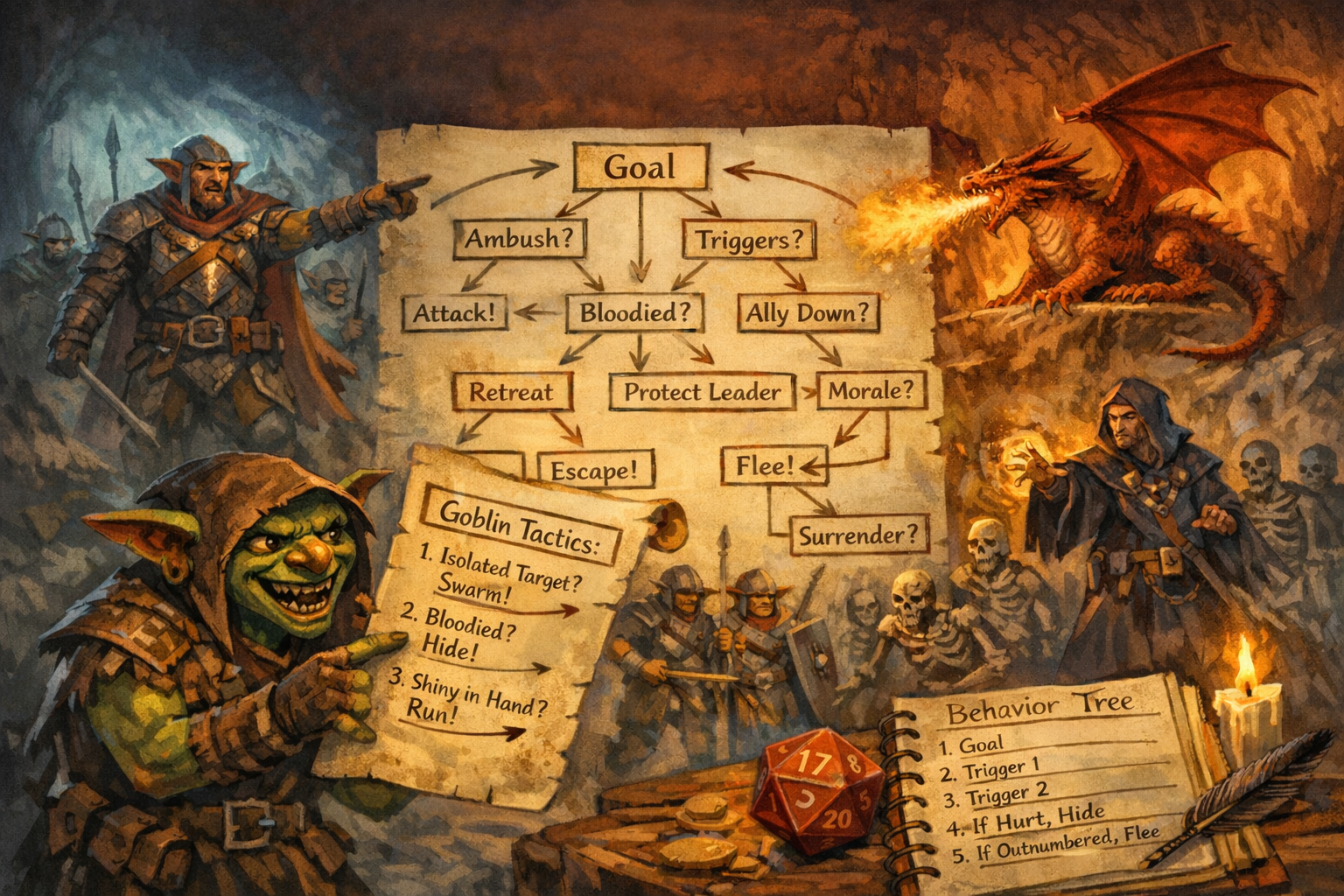
A monster behavior tree is a tiny decision engine that tells you what the creature wants and what it does when that want is threatened. Think of it as a three-to-ten line script you can run in your head. It’s a set of priorities. And when priorities collide with player choices, the fight becomes a story with teeth.
This post gives you a quick method you can prep in about thirty seconds per creature, plus a handful of ready-to-steal examples. You’ll leave with monsters that flank, retreat, bargain, panic, protect each other, and occasionally do something beautifully terrible.
What a behavior tree is (in plain tabletop language)
In video games, a behavior tree is a hierarchical list of “if/then” checks: the AI evaluates the most important condition first, and if it’s true, it performs that action. If not, it checks the next condition, and so on. Tabletop doesn’t need the software version. You just need the idea:
Monsters have a goal. Monsters have a style. Monsters have a breaking point. Monsters react to triggers in predictable ways.
A behavior tree is simply those things written down in the order you want them to matter.
The magic trick is not complexity. It’s consistency. Players learn patterns. They start predicting. They start counter-playing. That’s where tactics become gameplay instead of dice aerobics.
Why this works (and why it’s easier than “play them smart”)
“Play monsters smart” is advice with the same usefulness as “be funnier.” A behavior tree makes “smart” concrete by answering three questions:
- What does this monster most want right now?
- What is it afraid of?
- What does it do when the plan goes sideways?
Once those are written, you don’t need to out-think your table. You just need to follow the priorities you already decided.
Also: behavior trees are a fairness upgrade. When the dragon flees at half hit points, the players don’t feel cheated—they feel like they learned something about dragons. When the hobgoblins hold formation instead of chasing bait, the party feels like they’re fighting soldiers, not hit point balloons.
The 30-second method (the “index card AI”)
Grab an index card (physical or digital). Write five lines. Done.
Step 1: Pick the monster’s role
Forget the stat block for a moment. What job is this creature doing in this fight?
- Bruiser: hits hard, wants a duel, hates being kited.
- Skirmisher: hit-and-run, loves isolated targets.
- Artillery: ranged damage, wants distance and sightlines.
- Controller: slows, blinds, grapples, divides the party.
- Leader: buffs, commands, calls targets, protects allies.
- Lurker: ambush, vanish, strike, vanish again.
- Tank: blocks space, punishes movement, soaks attention.
- Solo/Boss: controls tempo, escalates, survives.
Step 2: Write the goal (one sentence)
Not “kill the party.” That’s the easy answer and usually the boring one.
Better goals:
- Drive intruders out without dying.
- Buy time until the ritual finishes.
- Capture one target alive.
- Escape with the relic.
- Test the heroes’ worth.
- Protect the young, the egg, the banner, the prisoner.
If you can’t say it simply, the monster probably doesn’t know it either.
Step 3: Choose three triggers
Triggers are the switches that make a fight feel alive. Pick three that you can notice fast.
Good triggers:
- Bloodied / below 50% HP (or any clear threshold your system uses).
- An ally drops.
- A leader dies.
- The monster gets restrained, blinded, or knocked prone.
- The party clusters (three PCs within a short distance).
- The monster’s escape route is blocked.
- The objective is threatened (relic grabbed, hostage freed).
- A PC repeats a signature tactic.
Avoid triggers you’ll forget, like “if the wizard looks smug.”
Step 4: Write a priority list (top to bottom)
This is the actual tree. Highest priority first.
A simple template:
- If the goal is failing, do the goal-saving move.
- If survival is threatened, do the survival move.
- If the signature move is available, use it.
- Otherwise, do the role move.
Step 5: Add a morale line
Morale is the secret sauce most combats never use. Morale can mean flee, surrender, bargain, call reinforcements, or switch targets to “escape route” or “hostage.”
Write a clear threshold: “At 30% HP or when the boss falls, break.”
That’s it. Five lines. Thirty seconds.
The 90-second boss version
Bosses benefit from two extra lines:
- Escalation: “On round 3 or when bloodied, change the rules.”
- Villain move: “Once per fight, do something that shifts the scene.”
Examples: collapse a balcony, cut a rope bridge, activate a glyph, drink a potion, scream for the hounds, rip the mask off and reveal the second face. You’re not adding damage; you’re adding drama.
How to run a behavior tree at the table (without slowing down)
- Read your first line at the start of the monster’s turn. If it’s true, do it. If not, go to the next line.
- Narrate the tell. Monsters telegraph. The players should feel clever for responding.
“Smoke curls under the dragon’s throat; it inhales like a furnace.” - Keep it human. If a player does something wildly unexpected, you’re allowed to insert a new trigger mid-fight. That’s not cheating. That’s the monster learning.
- Don’t be a slave to it. Behavior trees are training wheels for your brain. When you can improvise confidently, do it. But when you’re tired, stressed, or juggling twelve goblins, the card keeps you honest.
Design knobs: harder or easier without touching stats
Tune difficulty by changing priorities instead of numbers. Harder usually means tighter coordination (focus fire, protect key units, spend big resources early, use cover and terrain). Easier usually means looser play (spread attacks, delay the signature move, flee or surrender sooner, waste time repositioning). Because players can observe behavior, the adjustment feels fair.
Templates you can copy-paste
Template A: Three-line mook
Goal: __________________________
- If (goal threatened), ______________________.
- If (hurt / scared), ________________________.
- Otherwise, _______________________________.
Template B: Squad enemy (leader + troops)
Leader Goal: _____________________
Leader priorities:
- If an ally is down, _______________________.
- If PCs cluster, __________________________.
- Otherwise, command: _____________________.
Troop priorities:
- If leader commands a target, focus it.
- If flanking is possible, take it.
- Otherwise, hold line / pressure / reposition.
Template C: Boss (solo)
Goal: __________________________
Escalation: On round ___ or at ___% HP, _______________________.
Morale: If escape is possible at ___% HP, attempt it.
- If the objective is within reach, take it (even if risky).
- If the party is clustered, use the big area move.
- If a key PC is exposed (isolated, low defense, downed ally nearby), punish it.
- If control effects are shutting me down, break control (move, shove, dispel, terrain).
- Otherwise, do the safest high-damage option.
Now let’s load your GM belt with examples.
Example 1: Goblin ambushers (skirmishers who love unfair fights)
Concept: Goblins are not brave. They are opportunists with knives. They win by turning one mistake into six stabbing problems.
Goal: Steal something shiny and escape; if cornered, hurt whoever chases.
Triggers: A goblin drops; a PC is isolated; the shiny is grabbed back.
Morale: Break at 40% HP or when half the goblins fall.
Goblin behavior tree (mook)
- If I can attack with advantage (from hiding, flanking, prone target), do that.
- If I cannot attack safely, withdraw and hide or move to cover.
- If a PC is isolated, swarm that PC (two goblins commit; others harass).
- If the shiny is in hand and the escape lane is open, run—shouting insults.
- Otherwise, throw a weapon or take a cheap shot and reposition.
Goblin boss tweak (leader)
- If a goblin is down, order two goblins to drag the body away (denies easy confirms).
- If the party clusters, order a pepper attack: arrows at casters, then fall back.
- If the boss is hit hard, use a hostage tactic (grab, threaten, bargain).
GM notes: The hide/reposition line keeps goblins mobile and annoying. Give them simple signals (whistles, thrown stones, fake retreats) so the fight feels coordinated.
Example 2: Hobgoblin squad (disciplined soldiers with a plan)
Concept: Hobgoblins don’t fight to win the moment. They fight to win the engagement. They use space, timing, and mutual protection.
Goal: Hold the choke point until reinforcements arrive.
Triggers: The line is breached; commander is threatened; PCs try to bypass.
Morale: Break at 30% HP or when the commander falls (unless fanatical).
Commander tree
- If a PC breaks through the line, order a shield-turn: two soldiers intercept and block.
- If PCs cluster, call Volley (focus ranged fire on the cluster/backline).
- If an ally is down, order a drag-back (one pulls, another covers).
- Otherwise, mark a target and coordinate focus: “Blue cloak!”
Soldier tree
- If commanded to focus a target, do it.
- If an ally is threatened in melee, protect the ally (shove, body-block, reaction).
- If the line is intact, hold it (ready actions, punish movement, maintain formation).
- Otherwise, reform the line (move to re-create the choke point).
GM notes: Formation is a weapon. Describe it clearly, then let clever play break it.
Example 3: Wolves (or any pack predator)
Concept: Packs don’t spread damage evenly. They isolate and collapse.
Goal: Drag prey down, secure a meal, avoid serious injury.
Triggers: A target is prone; a wolf is badly hurt; the pack loses numbers.
Morale: If two wolves fall or a fire source threatens them, disengage.
Pack tree
- If a target is isolated, all wolves converge: knock prone, then bite.
- If a target is prone, focus it until it stops moving.
- If fire/bright light appears, circle wide and test the edge of the danger.
- If a wolf drops below 25% HP, it retreats and howls (calls more or warns pack).
- Otherwise, harry: bite, pull back, bait pursuit into rough terrain.
GM notes: Packs create motion. Motion creates choices.
Example 4: Gelatinous cube (or any mindless hazard monster)
Concept: Mindless doesn’t mean random. It means simple priorities.
Goal: Consume; keep moving; ignore distractions unless physically blocked.
Triggers: Multiple targets in path; blocked corridor; obvious heat/fire threat.
Morale: None.
Cube tree
- If two or more targets are in a straight line, move to engulf them.
- If a target is restrained/trapped, move to engulf that target.
- If blocked, press until the obstacle gives; if it doesn’t, flow around (if possible).
- Otherwise, continue along the corridor toward the nearest movement/noise.
GM notes: Hazard monsters shine when you treat them like environmental physics. They don’t taunt. They don’t chase intelligently. They just make the battlefield unsafe in a consistent way.
Example 5: Cult leader and acolytes (protect the concentration)
Concept: Casters aren’t scary because of raw damage. They’re scary because they get to keep casting.
Goal: Complete the ritual; keep the leader alive; delay pursuers.
Triggers: Concentration is threatened; ritual circle is invaded; an acolyte dies.
Morale: If the leader falls, acolytes scatter or surrender; if ritual fails, bargain.
Leader tree
- If the ritual is threatened, use control to push/hold enemies out of the circle.
- If concentration is threatened, retreat behind bodies/cover; demand protection.
- If a healer/controller is exposed, target them (silence, fear, stun, etc.).
- Otherwise, advance the ritual (buffs, summons, terrain hazards).
Acolyte tree
- If the leader is threatened, interpose (grapple, shove, body-block, impose disadvantage).
- If a PC enters the circle, restrain or shove them out, even at personal risk.
- If the leader commands a target, focus it.
- Otherwise, harass: flanking, ranged attacks, and denial of movement.
GM notes: You don’t need perfect rules knowledge to run this. Your AI is: keep the caster casting. That single priority makes the whole encounter feel like a coordinated enemy force.
Example 6: Undead guardroom (skeletons and zombies as different problems)
Undead are a gift to behavior trees because their motives are simple, but their styles differ.
Skeletons (mobile, tactical)
Goal: Prevent entry; eliminate intruders efficiently.
Triggers: Ranged attackers appear; formation breaks; a commander is present.
Morale: None unless controlled by a mind.
Skeleton tree
- If a ranged attacker is visible, return fire from cover.
- If a target is exposed in the open, focus it.
- If the line is threatened, reposition to maintain firing lanes.
- Otherwise, steady volleys and disciplined movement.
Zombies (slow, relentless)
Goal: Grab, pin, overwhelm.
Triggers: A target is isolated; a target is prone; a target is bleeding/weak.
Morale: None.
Zombie tree
- If a target is within reach, grab/hold (or the system’s equivalent).
- If a target is down, swarm and prevent rescue.
- If the crowd is tight, push forward as a wall.
- Otherwise, shamble toward the nearest living creature.
GM notes: The difference is not smart versus dumb. It’s ranged control versus space denial. Players will feel the difference immediately.
Example 7: Young dragon (the “I am the terrain now” boss)
Concept: Dragons are apex predators, but also arrogant. They don’t stand still and trade hits unless forced.
Goal: Protect lair and hoard; test intruders; survive to fight another day.
Triggers: Breath weapon available; hoard threatened; dragon bloodied; PCs cluster.
Morale: At 35% HP, attempt to escape or bargain unless magically compelled.
Dragon tree (solo)
Escalation: When bloodied, the lair becomes hostile—collapsing ledges, choking fumes, animated vines, whatever fits the dragon’s domain.
- If three or more enemies cluster, use breath (or the big area move).
- If a key ranged threat is exposed (archer, blaster, healer), strafe or pounce them.
- If grounded and surrounded, use movement/terrain to break contact (wing buffet, shove, climb, flight).
- If the hoard is being grabbed, prioritize the thief—even over optimal damage.
- Otherwise, attack from advantage: flyby, reach attacks, hit-and-run.
Morale: If escape route is open at 35% HP, take it; otherwise bargain, then betray if it becomes safe.
GM notes: The hoard line matters. It creates a non-HP objective. Players who try to steal mid-fight should feel the dragon’s attention snap like a trap.
How to build trees fast for any creature (a repeatable mini-workflow)
When you crack open a stat block, highlight three things:
- The signature move. What’s the thing the creature wants to do? Breath weapon, paralysis, shove, charm, grapple, web, rage. That’s your “if available, do it” line.
- The survival tool. Flight, invisibility, burrow, smoke bombs, bodyguards, tunnel exits. That’s your “if threatened, do it” line.
- The constraint. Slow speed, low range, sunlight weakness, fear of fire, oath, obsession, hunger. Constraints create interesting triggers because they limit behavior.
Then write the goal, pick triggers, and order priorities. You can do this while your players refill snacks.
Behavior trees for mixed groups (because encounters are ecosystems)
Real fights are rarely six identical enemies. The best behavior trees show relationships.
A simple method: give each creature a job, then write one line about how it supports the others.
Example: Necromancer + skeletons + zombies
Necromancer goal: stay alive and keep control.
Skeleton job: protect necromancer from ranged threats.
Zombie job: glue the party in place so skeletons and necromancer can work.
Now each stat block becomes part of a machine.
How to make behavior trees readable (telegraphing without spoilers)
A common fear is that predictable behavior makes encounters easy. It doesn’t. It makes them learnable, and learnable enemies feel real.
Give tells:
- The ogre roars and points at the smallest hero: it’s about to charge.
- The priest’s chant becomes frantic: the ritual is near completion.
- The assassin vanishes and the candles gutter: it’s hunting the backline.
Players can still fail. They just fail with information, which is the good kind of failure. “We knew it was coming and we couldn’t stop it” is terrifying in a way “the GM surprised us” rarely is.
Morale rules: the underused superpower
Most systems have rules for hit points but not for fear. That’s on you. Morale gives you three benefits:
- Shorter combats when the outcome is obvious.
- A living world where enemies value survival.
- New story branches: prisoners, bargains, recurring villains.
Some morale triggers to steal:
- If the boss dies, the minions flee.
- If half the force falls, they retreat to the next room and fortify.
- If the treasure is lost, they switch to capture mode.
- If fire appears, beasts scatter.
- If confronted with holy symbols, undead hesitate (unless commanded).
This doesn’t remove drama. It relocates it. The fight becomes a chase, a negotiation, a hostage scene, or a desperate last stand—anything but the last ten minutes of mop-up.
Advanced spice: escalation without a stat rewrite
A great boss fight changes shape. Escalation is the easiest way to do that without fiddling numbers.
Escalation ideas:
- The floor breaks, splitting the battlefield.
- Reinforcements arrive—but they’re panicked, wounded, or unreliable.
- The boss reveals a second phase: new tactic, new target priority, new environment rule.
- The objective changes: “Stop the ritual” becomes “Escape the collapsing chamber.”
- The villain sacrifices an ally for power, and the remaining allies lose morale.
Write one escalation line on the boss card and you’re done.
Behavior trees outside combat
The same tool works for social scenes, chases, and investigations: give the NPC a goal, three triggers, and a morale line, then follow priorities instead of improvising wildly. It keeps non-combat scenes consistent and gives players levers they can learn.
Common pitfalls (and how to dodge them)
Pitfall 1: Trees that are too long. If you need to scroll, it’s too long. Five to ten lines is a sweet spot.
Pitfall 2: Trees that ignore the goal. If the monster’s goal is “escape with the relic” but it keeps trading blows for pride, your priorities are backwards. Either change the goal or change the tree.
Pitfall 3: Suicidal monsters by accident. If morale never triggers, every fight becomes a death match. That’s fine for some genres, but it’s rarely the default of a living world.
Pitfall 4: Smart monsters with dumb information. Enemies can’t react to what they don’t perceive. If the assassin doesn’t know the healer is the healer, don’t magically target them—give the assassin a trigger like “if a PC restores a downed ally, mark them.”
Pitfall 5: Neglecting terrain. A behavior tree that never mentions positioning leaves value on the table. Add one line: “If I can take cover or high ground, do it.”
A one-page quick checklist (print it in your brain)
Before the session:
- Role: what job does this monster do?
- Goal: what does it actually want?
- Signature move: what makes it special?
- Survival tool: how does it avoid dying?
- Triggers: what changes its behavior?
- Morale: when does it break?
- Escalation (bosses): when does the scene change?
During the fight:
- Check priorities top-down.
- Narrate the tell.
- Let the monster learn.
- Use morale to end mop-up.
- Let consequences persist.
After the fight:
- Ask: did the monster feel like itself?
- Steal what worked. Simplify what didn’t.
- Save the behavior tree; reuse it as a species template.
Closing thought: Monsters are characters, not math problems
A behavior tree is a tiny act of empathy. You’re imagining what it’s like to be the thing on the other side of the initiative tracker: hungry, cornered, loyal, frightened, arrogant, programmed, desperate. When you write those priorities down, the monster stops being a pile of numbers and becomes a participant in the story.
And the best part? Your players will start doing it too. They’ll learn patterns. They’ll plan. They’ll talk about how these hobgoblins fight the same way they talk about how the villain thinks. That’s the moment your combats graduate from “encounter” to “scene.”
Next time you prep a fight, don’t ask, “How many hit points should this monster have?” Ask, “What does it do when it’s winning… and what does it do when it’s losing?” Then write five lines, and let the table catch fire...in the fun way.
Until next time, Dear Readers...