Trial By Law: A Courtroom Kit for DMs
In the Criminal Justice System, the People are Represented By Two Separate But Equal Groups...
Dear Readers,
Few things in tabletop gaming feel as intimidating to run as a courtroom scene. A dungeon has doors, traps, treasure, and monsters. A trial has procedure, testimony, objections, social pressure, and the terrifying possibility that your players might decide to cross-examine the duke, accuse the magistrate, or cast a spell in front of the entire gallery. That sounds chaotic because it is chaotic. It is also one of the richest kinds of play a DM can offer.
A good courtroom session gives players something combat cannot. It tests judgment instead of armor class. It forces the party to think in public. It creates consequences that feel civilized on the surface and ruthless underneath. A goblin raid can cost lives, but a legal ruling can cost land, titles, church standing, trade rights, custody, inheritance, freedom, or reputation. In fantasy worlds where the sword settles many disputes, the courtroom becomes the place where power bothers to dress itself in robes and pretend it is impartial.
That is exactly why courtroom adventures work.
They let the paladin wrestle with truth and mercy. They let the rogue weaponize details. They let the bard do more than charm a tavern crowd. They give the wizard a reason to care about precedent, magical evidence, and the limits of divination. Even the barbarian has a place, whether as a witness, a symbol of raw honesty, or the one party member who notices that the bailiff is wearing a murderer’s ring.
The trick is making the trial playable.
Many DMs avoid courtroom material because they fear one of two extremes. Either the trial turns into pure improv, where nothing has weight and the verdict feels arbitrary, or it becomes a dry legal simulation that buries the table in procedure. Neither extreme is necessary. What you want is a structure sturdy enough to create tension and loose enough to let players feel clever. Think of a courtroom not as a law lecture, but as a social dungeon. It has rooms, roles, traps, factions, hidden information, and encounter pacing. The party is still exploring. They are simply exploring truth under pressure.
So let us build a courtroom toolkit you can actually use.
First, decide what the trial is really about
Before you write a single witness statement, answer one question: what is the emotional center of this case?
Not the charge. The charge is surface. The emotional center is what the players are really fighting over.
Is this trial about whether the innocent will be crushed by a corrupt system? Is it about whether the law can contain a supernatural threat? Is it about a noble family trying to bury scandal? Is it about whether the party can prove that a confessed criminal acted under enchantment? Is it about public truth versus private loyalty? Is it about whether a city values order more than justice?
When you know the emotional center, everything sharpens. Your judge’s attitude, your opposing counsel’s tactics, the mood of the gallery, the kind of evidence that matters, and the final ruling all become easier to frame. A murder trial about inheritance should feel different from a heresy trial involving celestial visions. A treason hearing in a paranoid kingdom should feel different from a civil dispute between guilds in a bustling trade city.
A courtroom scene becomes memorable when it is not merely “someone is accused of something,” but “the law is being asked to reveal what this culture really believes.”
That gives your session teeth.
Choose the legal style of your setting
Not every fantasy courtroom should feel like a modern court. In fact, it usually should not.
Ask yourself what kind of justice system fits your setting. Is it feudal, ecclesiastical, arcane, mercantile, imperial, tribal, or deeply local? A dwarven hold might prize sworn craft records and lineage testimony. A temple court might rely on confession, penance, and testimony from recognized spiritual authorities. A mage republic might permit illusion replay evidence but ban enchantment-derived admissions. A frontier barony may have a magistrate who is judge, jury, and sentence in one weary body.
The point is not realism for its own sake. The point is flavor that shapes play.
Here are a few quick models:
The King’s Court: Procedure matters, but rank matters more. Nobles receive deference. Commoners need champions. Political pressure hangs over every ruling.
Temple Tribunal: Sin, intent, and repentance matter as much as facts. Miracles may be admissible, but only from approved clergy. False testimony risks spiritual consequences.
Guild Court: Contracts, coin, witnesses, and reputation dominate. Technicalities are weapons. Fines may matter more than imprisonment.
Magisterial Arcane Court: Magical evidence is powerful but heavily regulated. Spells can reveal truth, but countermeasures, wards, and legal restrictions make magic contested rather than automatic.
Village Moot: Everyone knows everyone. Reputation is evidence. The gallery is half the trial, because public memory shapes the verdict.
Pick one strong style and let the whole trial breathe through it.
Build the courtroom like an encounter map
Even if you never draw the room, think spatially.
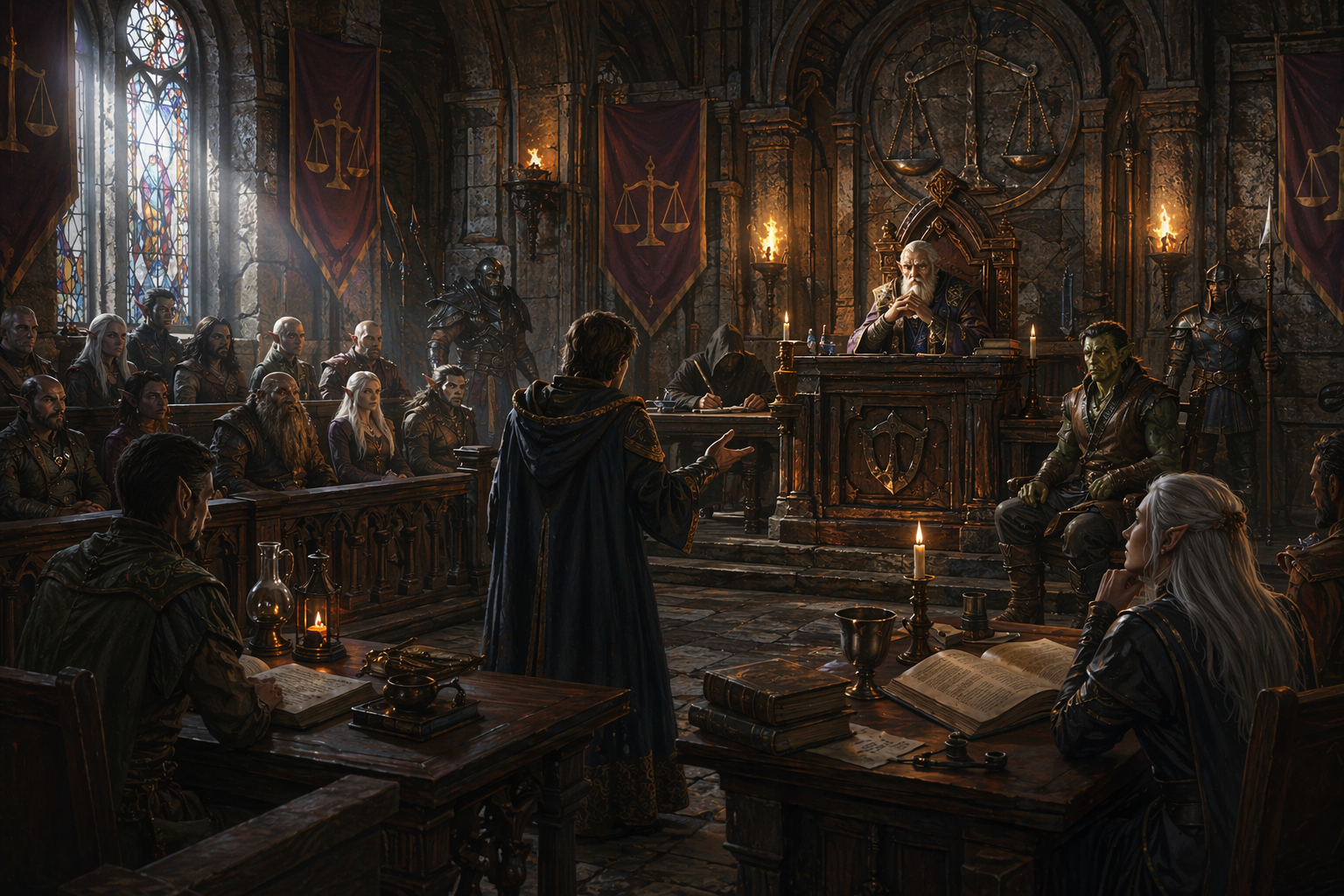
Who sits where? Who can whisper to whom? Where are the guards? Can the gallery interrupt? Is there a public floor for advocates? Are prisoners chained, boxed in iron, ringed by anti-magic sigils, or standing free under oath? Is the judge elevated? Are there scribes? Holy icons? Noble balconies? A side chamber for private consultation? A vault where physical evidence is stored?
This matters because players interact with space. The rogue may want to slip a note to a witness. The warlock may watch the spectators instead of the speaker. The ranger may notice muddy boots on a clerk who claimed never to leave the archive. A loud reaction from the gallery might change the judge’s mood. A witness who must cross a long chamber to take the stand gives your players time to study body language.
Treat the room as actionable. Courtrooms are stages, and stagecraft makes drama easier.
Give every trial five moving parts
A courtroom session becomes manageable when you break it into five parts:
The Charge: What is being alleged, and what is the possible consequence?
The Authority: Who has the power to decide?
The Pressure: What outside force is trying to shape the result?
The Evidence: What facts, objects, testimony, or magic can influence judgment?
The Twist: What hidden truth can change the direction of the case?
If you have those five parts, you have a trial.
For example: the charge is necromantic murder. The authority is a temple judge. The pressure is a frightened populace demanding swift punishment. The evidence is a bloodstained ritual blade, conflicting witness statements, and a partially corrupted Speak with Dead. The twist is that the victim volunteered for the ritual because he believed it would seal a greater evil.
Now the case has movement.
Decide the players’ role before the session starts
The party cannot do everything at once. Decide what they are in this legal drama.
They might be the accused. They might be defense advocates. They might be investigators hired to uncover facts before the verdict. They might serve as expert witnesses, champions of a patron, bodyguards protecting a key witness, or unofficial meddlers with just enough standing to be tolerated. They might even be prosecutors in a morally messy case.
Your chosen role determines what kind of fun the session delivers.
If the players are the accused, the focus is survival, credibility, and damage control. If they are defense advocates, the focus is strategy and persuasion. If they are investigators working during the trial, the session can cut between courtroom exchanges and urgent fact-finding outside the chamber. If they are expert witnesses, the fun lies in presenting specialized knowledge under hostile questioning.
Tell yourself what lanes are open. Then write for those lanes.
Create three kinds of evidence
Do not flood the table with ten equal clues. That makes courtroom play feel muddy. Instead, build evidence in three layers.
Core evidence is what the case publicly rests on. These are the things everybody knows: the body, the contract, the weapon, the confession, the accusation.
Contested evidence is where the drama lives. These are facts with multiple interpretations: a spell residue, an eyewitness who saw a silhouette, an unsigned ledger, a motive that points in several directions.
Hidden evidence is what the players can uncover to shift momentum: a forged seal, a bribed guard, a missing page, a cursed object, a witness under magical coercion, a family secret, or proof that the law itself is being manipulated.
This layered approach solves a common DM problem. It prevents the trial from ending instantly because of one obvious clue, while also preventing the session from stalling because nothing seems to matter. The public case gives structure. The contested evidence gives argument. The hidden evidence gives the players room to feel brilliant.
Make witnesses into encounters
A witness should never just be a box full of exposition.
Give each important witness three traits: what they know, what they want, and what they fear.
That simple trio transforms testimony.
A stable hand may know he saw the victim arguing with a veiled woman. He wants to avoid offending his employer. He fears being accused of theft if his own whereabouts are examined. Suddenly he does not speak like a transcript. He dodges, softens, and panics in believable places.
A priest may know the accused sought sanctuary. She wants the law to respect temple boundaries. She fears revealing that sacred relics went missing the same night. A city guard captain may know the arrest was rushed. He wants to protect the institution. He fears his men will look incompetent or corrupt.
Now the players can do something with testimony. They can reassure, corner, flatter, expose, threaten, or strategically leave something unsaid.
That is gameplay.
Use objections as pacing tools, not homework
You do not need a law degree to run objections. You only need a few clear categories that create friction.
Keep it simple. In your world, objections might revolve around relevance, speculation, magical tampering, improper coercion, lack of standing, insulting the court, or introducing forbidden evidence. That is enough.
The purpose of objections is not accuracy. It is rhythm.
An objection can stop a player’s momentum, force them to rephrase, reveal that opposing counsel is sharp, or signal that the judge has limits. It turns a speech into an exchange. It creates the feeling that the courtroom pushes back.
Use them sparingly and with intent. Too many objections become static. The right few make the scene feel alive.
Let skills matter, but never alone
Courtroom play should reward roleplay, but it should not punish players who are less verbally flashy. At the same time, one Persuasion roll should not decide the fate of the case.
The sweet spot is layered resolution.
Let speeches, questions, and tactics establish what kind of roll applies and how effective it can be. Then let the roll measure impact. Insight can read a witness. Investigation can catch contradictions in a written statement. Religion or Arcana can challenge sacred or magical claims. History can establish precedent. Performance can sway the gallery. Persuasion can soften the judge. Intimidation can backfire unless used with exquisite care. Deception can work, but every lie should leave embers.
I like to track courtroom momentum with a hidden scale. Strong questioning, sharp evidence, and good rolls push momentum one way or the other. The verdict is influenced by cumulative momentum, not one dramatic moment alone. That keeps the session fair while still allowing standout scenes.
Remember that magic changes the law
Fantasy courtrooms become interesting when magic is not an instant answer, but a legal problem.
Zone of Truth does not end all debate. People can refuse to speak. They can speak selectively. They can believe false things. A noble may be legally exempt from compulsory truth magic. A church may claim exclusive authority to administer such rites. A devil’s contract may hinge on technically truthful phrasing.
Detect Thoughts might be restricted as invasive sorcery. Speak with Dead may be admissible only if the body is verified and the soul is not compromised. Illusions can recreate events, but only if their source is trusted. Divination may be revered in one kingdom and banned in another after a prophetic coup a century ago.
This is gold for DMs.
When magic enters the courtroom, do not ask, “How does this solve the case?” Ask, “What new argument does this create?” That keeps spellcasters powerful without making the trial collapse.
Put a clock on the case
Trials need pressure.
Maybe the execution is at dawn. Maybe the harvest charter must be ruled on before the river opens. Maybe the prince leaves the city tomorrow. Maybe public unrest is rising. Maybe a demon bound beneath the courthouse grows stronger every hour the relic remains unsealed in evidence storage.
A clock matters because it prevents endless argument. It pushes the players to prioritize. It makes every recess meaningful. It creates the possibility of outside action between sessions or between trial phases.
Courtroom play without time pressure can drift. Courtroom play with a clock becomes urgent.
Use the gallery like weather
The spectators in a courtroom are not decoration. They are atmosphere with opinions.
A sympathetic gallery can embolden witnesses, pressure the judge, and give the party moral energy. A hostile crowd can rattle the accused, turn every stumble into scandal, and make even good points land poorly. Nobles whispering in a balcony create a different pressure from grieving dockworkers packed onto benches. Clerics with prayer beads send a different message than masked guild representatives taking notes.
You do not need the crowd to vote. You need it to react.
Gasps, mutters, applause quickly silenced by guards, scandalized silence, visible fear, prayer, anger, or shifting rumor all help players feel that words have weight. The law may be spoken by one judge, but it is heard by many ears.
Prepare a recess phase
One of the best tools in a courtroom session is the recess.
A recess gives everyone permission to breathe. It also opens the game back up. During recess, players can chase leads, confront witnesses privately, secure documents, pray for guidance, bribe a clerk, sneak into evidence storage, cast spells away from public scrutiny, or discover that opposing counsel is meeting with the real villain.
This is where courtroom adventures stop feeling static. The trial becomes a spine, and the recesses become side passages in the social dungeon.
Try alternating between hearing and recess. Opening arguments, then a recess. First witness, then a recess. Surprise evidence, then a recess. That structure keeps the session dynamic.
Do not fear partial victories
Not every good courtroom ending is full acquittal.
A player victory might mean the accused avoids execution but is exiled. It might mean the court rules in their favor publicly while secretly exposing a bigger conspiracy. It might mean they lose the case but win the crowd, triggering future rebellion or reform. It might mean the judge declares mistrial, buying time. It might mean a guilty client receives mercy because the players proved coercion, possession, or necessity.
Partial victories feel especially rich in legal stories because law is rarely clean. A courtroom can produce bittersweet endings that combat rarely does.
Use that.
A fast framework you can drop into almost any campaign
If you want a simple method at the table, use this framework:
Start with a charge and consequence.
Create one judge, one opposing advocate, three important witnesses, and one hidden hand behind the case.
Prepare three public pieces of evidence and two hidden ones.
Set a pressure clock.
Track courtroom momentum from minus three to plus three.
At minus three, the verdict is harsh. At zero, the result is mixed. At plus three, the players secure their best likely outcome.
Every strong argument, exposed lie, meaningful discovery, or clever legal maneuver shifts momentum by one. Every blunder, broken decorum, obvious lie, failed stunt, or missed contradiction shifts it the other way.
That is enough to run a memorable trial without drowning in paperwork.
Three instant trial hooks
If you want to test this toolkit quickly, drop in one of these cases. In the first, a beloved knight confesses to slaying a bishop, but the confession was given after a nightmare visitation no one can explain. In the second, a river guild sues a druid circle after enchanted roots destroy a toll bridge, and both sides are technically right. In the third, the corpse of an executed smuggler speaks during a funeral procession and names the magistrate as his partner.
Each hook gives you conflict beyond guilt or innocence. The knight’s case asks whether supernatural influence reduces responsibility. The guild dispute asks whether the law values commerce over sacred land. The smuggler’s accusation asks whether the court can survive judging one of its own. Any of them can become a full session with only a judge, a few witnesses, one hidden truth, and a deadline.
That is the beauty of courtroom play. You do not need pages of statutes. You need pressure, testimony, secrets, and stakes the players can feel.
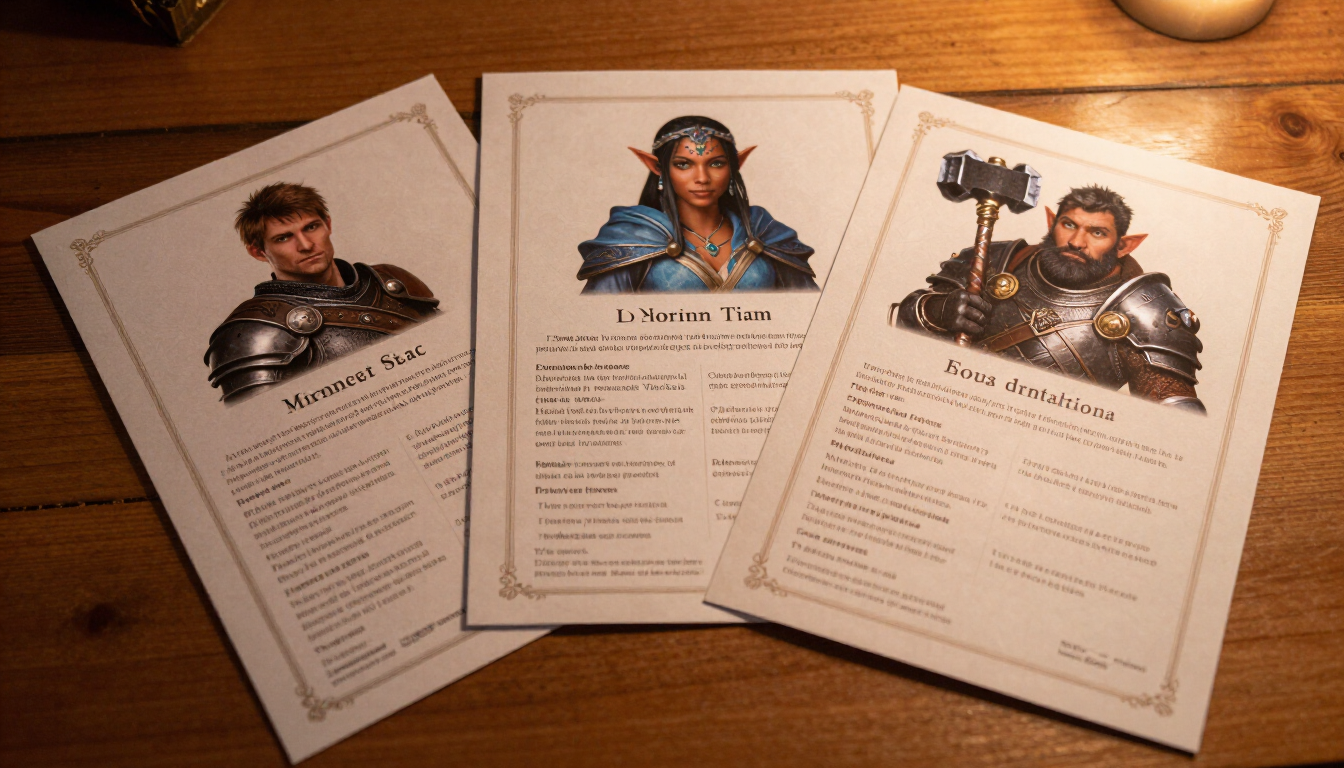
One last trick: give the party a physical prop. Hand them a copied warrant, a stained deposition, a sketch of the courtroom, or a letter bearing a broken seal. Tangible props slow players down in the best way. They read carefully. They pass evidence around. They begin treating the case like something they can hold instead of a speech they must remember. Courtroom sessions thrive on that shift. Once the table starts circling a document, arguing over a phrase, or pointing at a signature, you know the law has become part of the adventure rather than a pause between adventures.
Final advice: make the law personal
The best courtroom scenes are never about abstract procedure alone. They are about people using procedure to wound, protect, hide, confess, survive, and reveal.
So make the case personal.
Let the defendant be someone the players know. Let the prosecutor be morally understandable. Let the judge have a private scar tied to the subject of the case. Let the witness everyone dismisses hold the one detail that matters. Let the law expose a cultural fault line in your setting. Let truth cost something.
If you do that, your courtroom session will not feel like a detour away from adventure.
It will feel like adventure wearing formal clothes.
And that, Dear Readers, is where some of the finest drama in tabletop gaming lives. Not in the clash of steel alone, but in the moment when a room falls silent, a witness hesitates, the dice tumble, and everyone at the table realizes that justice, like any dragon, is most dangerous when cornered.
Until next time, Dear Readers...