The GM Skill Tree: Leveling Up as a Dungeon Master on Purpose
Leveling isn't just for PCs!
Dear Readers,
Let's be honest with ourselves: if Dungeon Masters had visible character sheets, most of us would forget to level ourselves up.
We track experience for every goblin the party looks at, but our own growth as GMs? That usually happens by accident, somewhere between “I guess I’ll run Lost Mines again” and “why are my players crying over an owlbear we just met?”
This post is about changing that.
Welcome to the GM Skill Tree—a way of thinking about Dungeon Mastering where you level up on purpose. Instead of vaguely hoping you’ll “get better someday,” you’ll look at your strengths, choose where to grow next, and take specific “quests” to unlock new abilities.
No new rules. No new system. Just a mindset shift and a handful of practical tools you can start using in your next session.
Why a GM Skill Tree?
Skill trees work because they answer three questions:
- Where am I now?
- Where could I go next?
- What do I have to do to get there?
When you apply that to GMing, it does a few powerful things:
- It breaks down the vague idea of “being a good DM” into clear, learnable skills.
- It keeps you from comparing yourself to some mythical perfect GM on the internet.
- It lets you grow intentionally instead of reactively (“My last session was a mess, I guess I’ll just panic and fix everything at once”).
Think of this skill tree as modular. You don’t have to unlock every node. You don’t need to max out a branch. You just decide: “This is the kind of GM I want to be,” and then take steps that move you in that direction.
The Five Core Branches
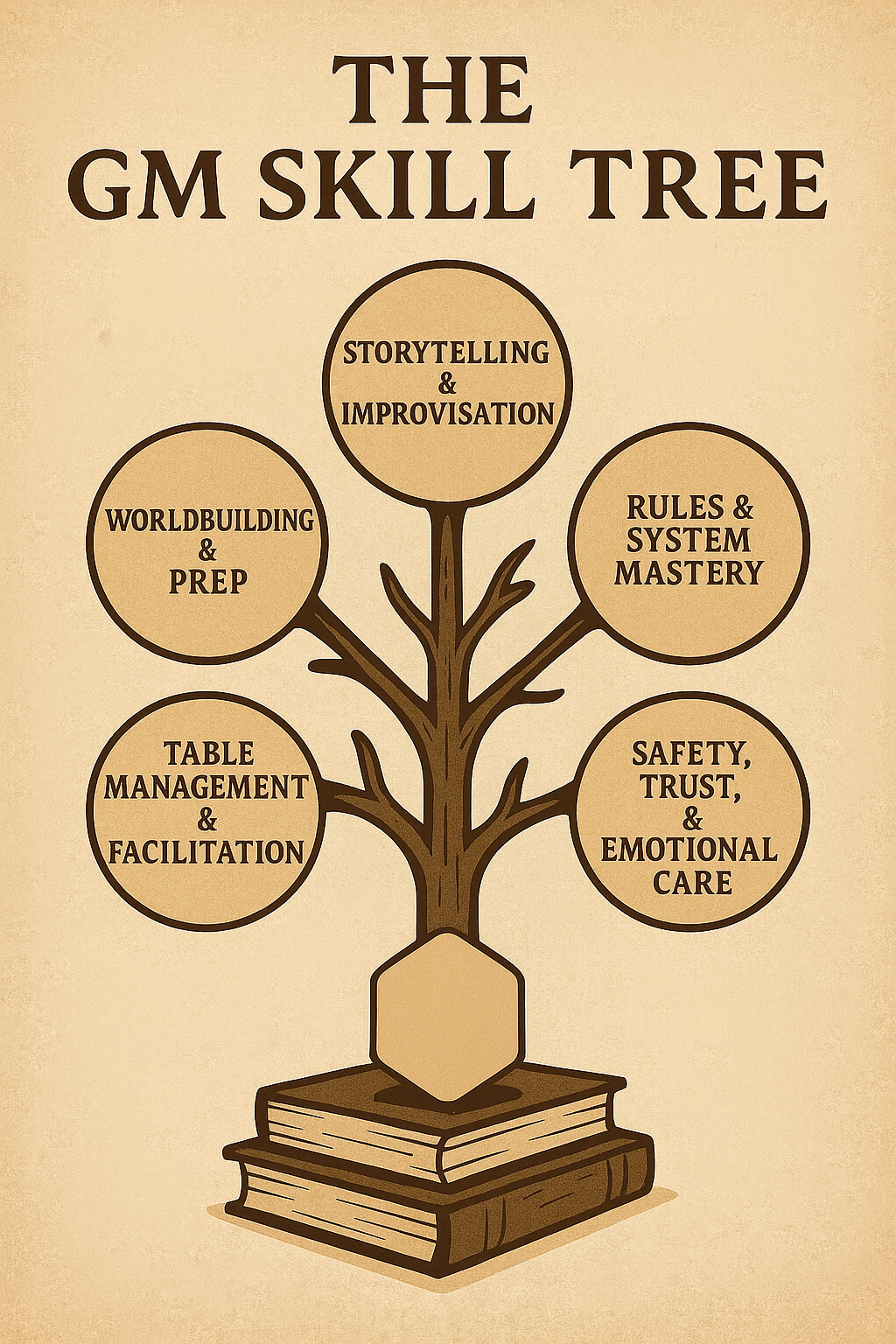
We’re going to focus on five main “branches” of the GM Skill Tree:
- Storytelling & Improvisation
- Worldbuilding & Prep
- Rules & System Mastery
- Table Management & Facilitation
- Safety, Trust, and Emotional Care
You can absolutely add more, like “Production & Props,” “GM-as-Performer,” or “Professional GMing,” but these five cover the foundation that almost every GM benefits from.
For each branch, we’ll look at:
- What the branch covers.
- A simple three-tier “node” structure.
- Concrete “quests” you can complete to level that branch up.
Grab a notebook or doc or mentally “check off” where you already are—and which node you want to chase next.
Branch 1: Storytelling & Improvisation
This is the branch most people picture when they think “great GM”: spinning scenes out of thin air, reacting to unexpected player choices, and making the story feel like it was always meant to go that way.
Node 1: Scene Builder
You can:
- Frame scenes with a clear who, where, and what’s at stake.
- Offer players meaningful choices, not just “door A or door B.” This means real player agency.
- Give NPCs distinct voices, motives, or quirks, even if they’re simple. You don't have to be a voice actor to give them a voice.
Quests to unlock or strengthen this node:
- Before your next session, write down three sensory details for each major location (sound, smell, touch). Use at least one in play.
- Take one “throwaway” NPC (bartender, guard, random street vendor) and give them a secret or small personal goal. Let it show.
- Practice describing a room in 30 seconds or less out loud, focusing on what the PCs would notice first. Time yourself.
Node 2: Reactive Storyteller
You’re comfortable throwing away your plans when the players zig instead of zag. You can tie their wild ideas back into the story without visibly sweating.
You can:
- Take an unexpected choice and ask yourself, “How can this be true and interesting?” instead of saying no.
- Recycle unused ideas and encounters in new contexts.
- Let consequences echo: if they spare a villain, that matters later.
Quests:
- In your next session, commit to saying “yes, and…” or “yes, but…” at least five times when players propose off-the-wall ideas.
- Take an unused encounter or NPC from a past session and reintroduce it in a different place or form.
- After the session, write a quick “ripple log” of three consequences of what the party just did. Use at least one next time.
Node 3: Collaborative Narrator
You don’t just tell a story to your players—you tell a story with them.
You:
- Ask players questions like, “What rumor have you heard about this place?” or “How does this scene look like a moment from your backstory?”
- Let players narrate parts of the world, especially when they use skills or abilities.
- Treat the table as a writers’ room instead of a stage.
Quests:
- Once per session, ask a player to add a detail: “What does the temple’s symbol look like?” “How do the locals greet one another?”
- When a player rolls a success on a social check, ask, “What does that look like?” and let them narrate.
- Run a short “flashback” or “spotlight” scene centered on one character’s backstory, with the player helping to define details.
Branch 2: Worldbuilding & Prep
This branch is about building a world that feels alive without burying yourself under a mountain of binders.
Node 1: Functional Prepper
You prep the right things, not everything.
You can:
- Sketch a simple adventure structure: hook → exploration → challenge → climax → aftermath.
- Prep just enough locations, NPCs, and clues to support your main beats.
- Avoid the “30 pages of lore nobody will read” trap. This is one that I, personally, struggle with. Seriously. Like, for a campaign, I wrote probably 3-5 pages of information on the specifics of the culture and practices of a tribe of indigenous peoples the party would be led to meeting. They got exposed to maybe 5% of it. I still look back on it with regret, not because of what I wrote, but because, unless I somehow make it relevant, the party will never know.
Quests:
- Before your next session, write a one-page outline with only these elements:
- Opening situation
- Three interesting locations
- Three named NPCs
- One twist
- Try running a one-shot with strict prep limits: one page of notes, one page of monsters, and that’s it.
- Take an old lore document and highlight only the bits that could show up at the table (legends, rumors, NPC beliefs). Ignore the rest for now.
Node 2: Living World Architect
Your world remembers what the players do.
You:
- Keep track of factions, their goals, and their evolving relationships.
- Update locations to reflect past adventures.
- Let time pass and things change off-screen.
Quests:
- Draw a faction map with 3–5 groups, their goals, and arrows showing how they feel about each other. After each session, adjust it. Dungeons of Drakkenheim, as an example, does a WONDERFUL job at this one; definitely worth reading
- Before a session, pick one familiar location and write how it has changed because of the party’s actions.
- Create a “world clock”: 3–4 looming events that advance every few sessions, regardless of the party, unless they intervene.
Node 3: Theme Weaver
You design your world to explore intentional themes: corruption and redemption, hope in dark times, the cost of power, found family, faith versus fanaticism, and so on.
You:
- Pick 1–2 themes and let them echo in locations, villains, rumors, and downtime scenes.
- Ask how each major NPC or faction relates to those themes.
- Use recurring imagery, symbols, or choices that highlight those big ideas.
Quests:
- Pick a theme for your current campaign and write it at the top of your notes. For each major NPC, note how they express or resist that theme.
- Introduce a symbol that keeps appearing: a sigil, a melody, a proverb. Let it take on new meaning over time.
- In your next session, frame one scene that forces the party to choose between two values that matter to them. Let the result echo.
Branch 3: Rules & System Mastery
This isn’t about becoming a walking encyclopaedia. It’s about knowing the rules well enough to use them as tools for fun, not shackles.
Node 1: Confident Basics
You know:
- How turns and actions work.
- How to run common checks, attacks, and saves.
- Where to quickly find information you’ve forgotten.
You’re not terrified of getting something “wrong,” because you’re comfortable ruling in the moment and looking it up later.
Quests:
- Make yourself a one-page cheat sheet of your system’s most common rules. Use it actively for a few sessions.
- During your next game, when a rule question comes up, say, “We’ll rule this way for now and look it up after the session.” Then actually look it up and jot a note.
- Watch or read a rules breakdown of one part of the game you always forget (conditions, spellcasting, downtime, whatever) and summarize it in your own words.
Node 2: Intent-Based Rulings
You understand why the rules exist, not just what they say.
You:
- Ask, “What is this rule trying to accomplish?” before deciding how to apply or bend it.
- Can tweak rules on the fly to keep the tone and pacing where you want them.
- Avoid arguments by explaining your reasoning clearly.
Quests:
- Pick a rule you dislike. Ask, “What problem is this rule trying to solve?” Then create a house rule that solves the same problem in a way you like better.
- Next time a rules dispute comes up, name what you’re protecting (“I want this to feel dangerous but not hopeless,” “We’re short on time, so I’m simplifying this”).
- Run a session where you consciously focus on pacing: if combat bogs down, simplify; if tension drops, tighten the screws.
Node 3: System Hacker
You can comfortably hack your system to fit your table.
You:
- Design new monsters, magic items, or playbooks/classes using existing ones as templates.
- Steal mechanics from other games and slot them in.
- Know which levers to pull to shift difficulty, tone, and complexity.
Quests:
- Reskin an existing monster or stat block into something totally different. Keep the numbers, change the story and abilities’ descriptions.
- Borrow a mechanic from another system: clocks, tokens, stress tracks, fronts, etc. Test it in a one-shot.
- Ask your players what kinds of challenges they enjoy most (social, tactical, puzzles, mysteries, horror) and adjust your system tweaks to lean into those.
Branch 4: Table Management & Facilitation
You can prep the best world in existence, but if the table is chaotic, awkward, or dominated by one loud personality, the game suffers. This branch is about running the room.
Node 1: Basic Table Captain
You:
- Start and end on time.
- Set clear expectations about scheduling, house rules, and communication.
- Make sure everyone gets at least some spotlight each session.
Quests:
- At the start of your next campaign, run a Session Zero with a simple agenda: tone, themes, lines & veils, house rules, schedule, and character connections.
- In your next session, track who has gotten spotlight moments. In the final hour, intentionally give scenes to the quieter players.
- Create a simple group chat or email with key info pinned: schedule, starting time, house rules, and how to contact you.
Node 2: Social Acrobat
You’re comfortable handling:
- Table distractions and side conversations.
- The quiet player who never speaks up.
- The enthusiastic player who steamrolls scenes.
You gently but firmly steer the social energy so the game keeps flowing.
Quests:
- Practice a few simple phrases for redirection, like:
- “Let’s put a pin in that side chat and come back to the scene.”
- “I want to hear what Alex thinks here.”
- “Let’s give someone else a shot at this one.”
- Talk privately with a quieter player between sessions and ask, “What helps you feel comfortable jumping in?” Adjust your style based on their answer.
- If someone dominates play, give them explicit moments to shine (“This is your detective scene”), then set clear handoffs to others.
Node 3: Group Alchemist
You intentionally shape the table into a cohesive group, not just “some people who show up on the same night.”
You:
- Notice and celebrate moments of cooperation, character growth, and emotional vulnerability.
- Encourage players to lift each other up, not just optimize their own builds.
- Build rituals and traditions that make the table feel special (recaps, victory toasts, end-of-arc awards, etc.).
Quests:
- Start each session with a PC recap: ask a different player each time to summarize last session from their character’s perspective.
- After a big milestone, do a quick “roses and thorns” debrief: one thing they loved, one thing they’d change.
- Create a small ritual: maybe you end each session with “who was MVP this week?” or you award a goofy in-world title to someone who did something memorable.
Branch 5: Safety, Trust, and Emotional Care
This is the branch that quietly powers all the others. When your players trust you, they’ll follow you into darker dungeons, sillier hijinks, and deeper emotional territory.
Node 1: Baseline Safety Tools
You:
- Know and use at least one safety tool (X-card, Script Change, lines & veils, etc.).
- Have a conversation about comfort zones and topics to avoid.
- Are clear that anyone can step back, fade to black, or pause a scene, no questions asked.
Quests:
- Read up on one safety tool you’re not using yet and introduce it at your next Session Zero.
- Ask your group privately (via message or form): “Anything you’d like to avoid or handle carefully?” Respect those answers and keep them confidential.
- In your next game, model safety by checking in after an intense scene: “Everyone good? Want to rewind, pause, or keep going?”
Node 2: Emotional Temperature Reader
You’re good at reading the room.
You:
- Can tell when tension is fun vs. when it’s uncomfortable.
- Notice when someone is withdrawing or getting overwhelmed.
- Are willing to slow or shift the game to take care of your people.
Quests:
- Pick two moments in your next session to silently check in with yourself: “How does the room feel right now?” Adjust pacing if needed.
- After a heavy or intense scene, offer a lighter beat: a joke, a small victory, a quiet character moment, or a time skip.
- If someone seems off, follow up after the session with a low-pressure message: “Just checking in—how are you feeling about the game?”
Node 3: Emotional Storyteller
You intentionally design moments that hit emotional notes—hope, grief, awe, camaraderie—while keeping your group’s safety in mind.
You:
- Know which themes and emotional beats your players enjoy.
- Use NPCs, callbacks, and recurring motifs to deepen those beats.
- Respect boundaries while still letting the story matter.
Quests:
- Ask your players what emotional flavors they enjoy: tragic heroism, spooky tension, cozy slice-of-life, big heroic triumphs, etc. Make a list.
- Plan one scene next session designed to hit one of those beats—a heartfelt conversation, a moment of hard-won victory, a quiet memorial.
- When a player has a strong emotional reaction (laughing hard, tearing up, fist-pumping), notice it and take a second to appreciate that the story landed.
Building Your Personal GM Skill Tree
Okay, that’s a lot of nodes. How do you actually use this without turning GMing into homework?
Here’s one way to do it:
- Pick two branches that matter most to you right now. Maybe you’re solid on rules but struggle with table chaos. Maybe you’re a killer storyteller but your prep is eating your life.
- In each branch, circle one node that feels like your next step. Not the ultimate ideal version of you—just the next rung on the ladder.
- Choose 2–3 quests from that node and commit to them for your next 3–5 sessions.
Treat it like a mini-campaign where you are the character leveling up.
You don’t need to do everything at once. In fact, please don’t. Pick a couple concrete experiments, try them, and then reflect:
- What felt easier?
- What felt awkward?
- What surprised you?
Then adjust and pick the next node.
Putting It All Together: A Three-Session Level-Up Plan
To make this even more concrete, let’s sketch a tiny “leveling plan” you can plug into your actual game nights.
Imagine you choose:
- Branch: Storytelling & Improvisation – Node 1 (Scene Builder)
- Branch: Table Management & Facilitation – Node 1 (Basic Table Captain)
You’re aiming to get better at framing scenes and running the room smoothly.
Session 1
- Before the game, prep three sensory details for each key location.
- Write your agenda on a sticky note: “Start on time, spotlight for Jamie, recap at the end.”
- During play, use at least one sensory detail per scene and end by asking one player to recap the session in-character.
Session 2
- Keep the sensory detail habit going.
- Track spotlight moments with quick tally marks next to each player’s name.
- Try one redirect phrase for table chatter: “Let’s jump back in—what are you all doing as the doors slam shut?”
Session 3
- Ask a player to define a detail (“What does the city’s main gate look like?”) to lean into collaborative narration.
- Run a quick “roses and thorns” at the end: one thing they liked, one thing they’d tweak.
- After the game, reflect for five minutes: what improved since Session 1? What still feels clunky?
That’s it. Nothing wild, nothing overwhelming—just intentional repetition around specific skills. You do that for a few cycles, and suddenly you look back and realize, “Huh. I used to struggle with this. Now it’s just how I run.”
EXP, Not Perfection
A quick but important reminder: you will mess up.
You’ll misread the room. You’ll forget a rule. You’ll prep way too much one week and nearly nothing the next. You’ll try a new safety tool and present it clumsily. You’ll improvise an NPC name you instantly regret (you have no idea how many characters named "Willem" are in my campaigns.
That’s not failure. That’s experience points.
Every time you notice something you want to improve, that’s your character sheet updating. “Ah. I rolled a 3 on ‘handling player disappointment.’ Noted. I’ll put a proficiency point there next level.”
What matters is that you’re paying attention on purpose.
When you treat GMing like a skill tree instead of a mysterious art you either have or don’t, a few things change:
- You start valuing small, concrete improvements over grand reinventions.
- You recognize that your players aren’t looking for a flawless performance—they’re looking for someone who cares enough to keep growing.
You already know how satisfying it is to watch your players level up, unlock new feats, and grow into their class fantasy. The GM Skill Tree is just that… but for you.
A Final Thought: Design Your Own Nodes
Everything above is a starting point, not a sacred text.
Your table is unique. Your values are unique. The way you want to show up as a GM is unique.
So once you’ve played with these five branches for a while, consider adding your own:
- Performance & Voices: accents, body language, music cues.
- Mystery Crafting: clues, red herrings, player-led theories.
- Tactical Design: dynamic battlefields, enemy AI, terrain.
- Professional GMing: session prep workflows, player onboarding, communication, and boundaries for paid games.
Write down the kind of GM you dream of being in a year. Not a fantasy superhero—just a version of you that’s moved a few nodes further along the tree.
Then ask: “What branch is that? What nodes did I unlock to get there?”
Turn those answers into quests. Try them, fail at a few, succeed at others, and track the XP as you go.
You don’t need permission from anyone to level up. You’re already doing it every time you sit behind the screen and guide your players through whatever wild, heartfelt, ridiculous stories you’re building together.
The only difference now is that you’re doing it on purpose.
Until next time, Dear Readers...